|
This page contains archived information and is no longer maintained. |
Documents > Archives > 1999 Senate Rules of Order > Senate Rules
|
This page contains archived information and is no longer maintained. |
Chapter 1
Rule 1.1. Regulation and control
- The President of the Senate shall regulate and have control over such parts of the capitol and capitol complex as are set apart for the use of the Senate and its officers.
- The President shall have general charge and supervision of the Senate Chamber and of all its physical facilities. He shall determine and be responsible for the physical arrangement and security of the Senate Chamber, the committee rooms, and the offices of the Senate and its officers. He may delegate any or all of these responsibilities to the Secretary of the Senate.
- The President shall provide for the administration and enforcement of the rules governing admission to the Senate.
Rule 1.2. Senate Chamber
- The Senate Chamber shall not be used as a public meeting place. It shall be used only by the Legislature, the Democratic State Central Committee, and the Republican State Central Committee, except that when the Legislature is not in session, the Pelican Boys State; the Pelican Girls State; the Jaycee Action, Silver Haired, Camp Fire Councils Youth, and YMCA Youth legislatures, the Young Democrats of Louisiana; and the College Republicans shall be allowed to use the chamber. The Secretary or his designee shall be present at each such meeting and shall supervise and control the use of the chamber and any of its facilities. Any such group desiring to use the chamber shall contact the Secretary at least thirty days prior to the date on which the meeting is scheduled.
- No meeting or public hearing of any legislative committee shall be held in the Senate Chamber at any time.
- The President shall designate a place in the Senate Chamber for the news media, and the members thereof shall have free access thereto. Accreditation of members of any news media for admission shall be administered by the President.
- The Senate Library and Sections C and D shall be for the exclusive use of members of the legislature and the persons designated in Senate Rule 1.3. No registered lobbyist shall be permitted in the Senate Library. Section B shall be for the exclusive use of the Senators and immediate members of their family. No other person shall be allowed to sit in this Section.
- No disruptive conversation shall be held in the Senate Chamber. No conversation shall be held within the chamber, except in the presence of a senator, nor shall any conversation be held across the rail.
- Seating facilities shall be provided for the public in the Senate gallery. Admittance shall be under such conditions as are determined by the President.
- A former member of the Senate, except one who is a registered lobbyist, may enter those portions of the Senate floor designated as Sections B, C, and D, the Senate Library, the office of the secretary, and that portion of the floor behind the secretary's desk.
Rule 1.3. Senate floor
- No person shall be admitted on the Senate floor while the Senate is in session or for thirty minutes before the time fixed for the convening of each session or for thirty minutes after adjournment of each session. However, members of the Senate and the Secretary, officers and employees of the Senate or of senators, members of the House of Representatives, the Clerk of the House, officers and employees of the House or of members of the House, the Legislative Auditor, the Legislative Fiscal Officer, and the employees of any of these shall be admitted to the floor. For the purposes of these rules, the Senate floor is defined as that area so designated in the diagram of the Senate Chamber included at the end of this rule.
- No member of any news media shall conduct any formal interview with a senator on the Senate floor while the Senate is in session.
- One chair, permanently affixed to the floor at the desk of each senator, and no other chairs shall be permitted in Section A of the floor of the Senate, except for the six chairs at the news media desks, and the chairs at the President's desk and the Secretary's desk, the number to be determined by the President.
- Special permission to enter those portions of the Senate floor designated as Sections B, C, and D, the Senate Library, the office of the Secretary, and that portion of the floor behind the Secretary's desk may be granted by the President to visiting officials of other states or of the United States or of foreign countries, or to other dignitaries.
- No person shall bring food or drink on the Senate Floor within the areas designated as Sections A, B, C, and D on the diagram contained in the rule, of a kind or in a manner which is disruptive of the decorum of the Senate, without special permission of the President.
SENATE CHAMBER
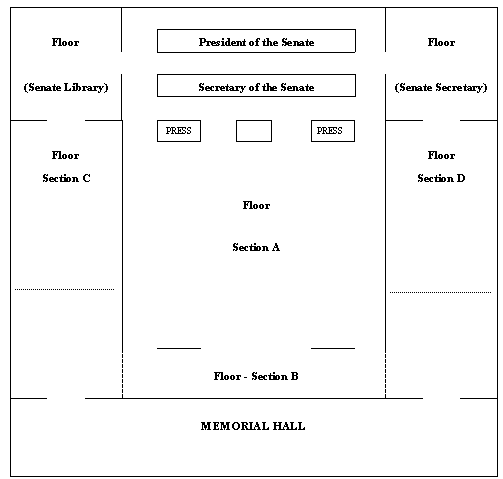
Chapter 2. Oath of Office
Rule 2.1. Members elected to full term; judging qualifications and elections; oath
Members of the Senate shall meet in the Senate Chamber at the state capitol at 10 a.m. on the second Monday in March after their election every four years and, after judging the qualifications and elections of the members required by Article III, Section 7 of the constitution, shall take the oath or affirmation of office prescribed by the constitution in open Senate.
Rule 2.2. Members elected to fill vacancies; oath
A person elected to fill the remainder of an unexpired term in the Senate shall take the oath or affirmation of office within thirty days after the secretary of state promulgates the election returns.
Rule 2.3. Administration of oaths or affirmations
The Secretary shall administer all oaths or affirmations, except that the President shall administer the oath to the Secretary.
Chapter 3. Officers
Rule 3.1. Officers
The officers of the Senate shall be a President, President Pro Tempore, Secretary and Sergeant at Arms.
Rule 3.2. President; election; removal; vacancy
- Immediately after the members take the oath of office on the second Monday in March after their election every four years, the President shall be elected by the affirmative vote of at least twenty members. The vote shall be viva voce.
- The President may be removed from that office during any session of the Legislature by the affirmative vote of at least twenty members. Removal of a President shall be accomplished by Senate Resolution introduced for the purpose of calling an election to elect a new President. The resolution shall state the day and time at which the election shall be held.
- The death, resignation, or removal from office of the President creates a vacancy in the office of President. A vacancy shall be filled for the remainder of the unexpired term in the same manner as the original election. A vacancy which occurs while the Legislature is in session shall be filled immediately; otherwise, the vacancy shall be filled at the next regular or extraordinary session.
- In case of the disability or temporary absence of the President which prevents him from carrying out the powers, duties, and responsibilities of his office, he shall certify the facts thereof to the President Pro Tempore. If he is unable or fails to so certify, the Senate may do so by roll call vote or mail ballot. The President, in like manner, shall certify to the termination of the disability or temporary absence. If a majority of the members elected to the Senate disagree with a certification of termination of disability or absence made by the President, the findings of the Senate, evidenced by roll call vote or mail ballot, shall prevail.
Rule 3.3. Duties of President
The President shall:
- Convene the Senate at the time fixed by Senate Rule 10.1 and shall open each session by taking the chair and calling the members to order.
- Preside at all sessions of the Senate, but he may designate any member to serve as presiding officer for a limited time, which shall not extend beyond adjournment each day.
- Cause the Senate to proceed with its business in the order established by the rules, if a quorum is present, and announce or direct the Secretary to announce the business before the Senate as the Senate proceeds upon each order of business.
- Preserve order and decorum, particularly as provided in these rules.
- Confine members to the question under consideration.
- Speak on points of order, and he shall have preference over other members in doing so.
- Decide all points of order, subject to appeal to the Senate as provided in Senate Rule 6.3.
- Explain or clarify any rule of procedure upon request.
- State, or direct the Secretary to state, each motion as it is made, as provided in Senate Rule 11.1.
- Recognize members who seek the floor for the purpose of speaking in debate or otherwise, but such recognition shall be in accordance with Senate Rules 6.5 and 6.6.
- State and put to a vote all questions requiring a vote or upon which a vote is ordered and announce the vote as provided in Senate Rules 12.5 and 12.8.
- Cast his vote when the Senate is equally divided; otherwise, he may but shall not be required to vote.
- Have general charge and supervision of the Senate Chamber and all physical facilities, particularly as provided in Chapter 1.
- Assemble the members in meetings during the interim between sessions or at any other time for any purpose he deems necessary or desirable and expend funds of the Senate to pay the expenses thereof, including per diem and travel expenses.
- Appoint or remove the members of each Senate and conference committee, except as otherwise provided by law, rule, or resolution, and appoint or remove the chairman and vice chairman of each committee, as provided by Senate Rule 13.2.
- Create select committees and appoint or remove the members thereof.
- Provide for a schedule of committee meetings, as provided by Senate Rules 13.69 and 13.70.
- Refer to standing committees all prefiled instruments or other matters to be referred to committee, as provided in Senate Rules 13.4 and 13.5.
- Sign all documents which require his signature, particularly as provided in Senate Rule 7.11.
- At his discretion, examine and correct the Journal.
- Have general charge and supervision over the Secretary and his assistants, the Sergeant at Arms and his assistants, and all employees of the Senate.
- Employ, fix the compensation, and have authority to discharge all Senate employees.
- Approve all expenditures of the Senate and its members and enter into contracts for the Senate and its members.
- Preside over joint sessions of the Legislature, as provided in Joint Rule No. 1.
- Do and perform such other duties as are required by the constitution and laws, the Legislature, or the Senate, and such other duties as may properly appertain to the office of the President.
- At his discretion, name any senator to perform any duties of the chair for a time he shall specify.
- Delegate any of his duties or functions to the President Pro Tempore.
- Appoint a parliamentarian.
- Have control and custody of all vehicles owned by or assigned to the Senate.
- Be responsible for the assignment and use of vehicles owned by or assigned to the Senate and may assign such vehicles for use by the staff for Senate business.
- Submit receipts or documentation supported by other evidence for all expenses for which reimbursement is sought pursuant to R.S. 24:503.
- Cause to be distributed reports covering interim activity from standing, joint, or special legislative or Senate committees or subcommittees to all members of the Senate, particularly Senators representing geographic areas included in the study.
Rule 3.4. President Pro Tempore; election; removal; vacancy
- The President Pro Tempore shall be elected by the members of the Senate from among the members thereof in the same manner as the President. He shall be elected every four years, and his election shall be the next order of business following election of the President.
- He may be removed from office in the same manner as the President.
- A vacancy in the office of President Pro Tempore shall be filled in the same manner as the original election.
Rule 3.5. President Pro Tempore; duties
The President Pro Tempore shall:
- In the absence of the President, preside or call a member to preside over the Senate.
- Upon the death or resignation of the President, assume the powers, duties, and emoluments of the President until a president is elected as provided in Senate Rule 3.2.
- In case of the disability or temporary absence of the President, assume the powers, duties, and responsibilities of the President until the termination of the disability or absence. The Senate shall make appropriate financial recompense to the President Pro Tempore for his service during such time.
- Determine the meeting time of the Senate, with concurrence of the Senate.
- Perform such other duties as are assigned to him by the President, the Senate, the state constitution or laws, the Joint Rules of the Senate and House, the Senate rules, or otherwise by the Legislature.
Rule 3.6. Secretary; election; removal; vacancy
- The Secretary shall be elected by the members of the Senate in the same manner as the President. He shall be elected every four years following election of the President Pro Tempore.
- He may be removed from office in the same manner as the President.
- The death, resignation, or removal from office of the Secretary creates a vacancy in the office. A vacancy shall be filled for the remainder of the unexpired term in the same manner as the original election. A vacancy which occurs while the legislature is in session shall be filled immediately. If the vacancy occurs when the Legislature is not in session, it shall be filled at the next regular or extraordinary session, and the President may appoint an Acing Secretary to serve until that time.
- In case of disability or temporary absence of the Secretary which prevents him from carrying out the duties of his office, the President may designate a person to serve as Acting Secretary during the period of the disability or absence.
Rule 3.7. Duties of Secretary
- The Secretary shall exercise the following general duties:
- Advise the officers and members of the Senate on parliamentary procedure and the Senate rules when called upon to do so.
- Be responsible for the keeping of all bills, resolutions, joint resolutions, papers, and records of the Senate and records of the proceedings and actions of the Senate.
- Insure compliance with Chapter 1, relative to use of Senate facilities.
- Arrange, number, and correct cross references in the Rules of Order of the Senate following any amendment thereto; effect a consistent and orderly arrangement of the rules; index the rules; exercise the same authorities, concurrently with the Clerk of the House, with respect to the Joint Rules.
- Supervise and direct all Senate employees and report to the President the failure of any employee or the Sergeant at Arms to perform his duties.
- Authenticate the Journal or any part thereof.
- Attest to the signature of the President on legislative instruments, writs, warrants, and subpoenas, as provided in Senate Rule 7.11.
- Perform all other duties prescribed by law, by these rules, or by the Senate.
- Faithfully and promptly execute all orders of the Senate, the President, and the Legislature.
- In the engrossment or reengrossment of Senate legislative instruments:
- To renumber or redesignate numerical or alphabetical listings to create a numerical or alphabetical sequence.
- To change reference numbers to agree with numbered chapters and sections.
- To substitute the proper chapter, section or other subdivision term for the terms "this act", "the preceding section", and the like.
- To delete figures where they are merely a repetition of written words and vice-versa.
- To change capitalization for the purposes of uniformity.
- To correct manifest punctuation and other typographical errors.
The Secretary shall exercise the following duties while the Legislature is in session.
- Maintain a Journal of the proceedings of the Senate and be responsible for its accuracy and, for this purpose, he may make necessary corrections in the Journal.
- Record in the Journal daily the members present and those absent.
- Be responsible for all legislative instruments and documents in the custody of the Senate, in passage from the Senate to the House, and in passage from the Senate to the governor, and keep them in proper order.
- Maintain the calendars of bills, resolutions, and joint resolutions to be taken up and acted upon by the Senate.
- Cause legislative instruments to be printed and distributed, as required in Senate Rule 7.6.
- Have enrolled all bills, joint resolutions, and concurrent resolutions originating in the Senate which have passed both houses, the enrollment to incorporate into the instrument all changes agreed upon by both houses, and he may have enrolled all Senate Resolutions adopted by the Senate, including all amendments adopted thereto.
- Endorse all legislative instruments which are enrolled, attesting to the accuracy of the enrollment thereof and to the signature of the President.
- Present legislative instruments of the Senate which have been signed by the President, except Senate Resolutions, to the Speaker of the House for signature.
- Present legislative instruments of the Senate, signed by the President and the Speaker of the House, to the governor.
- Keep a record, in the form of a receipt book, of all legislative instruments presented to the governor and the time of delivery.
- Publish legislative or Senate calendars, as required by Senate Rule 14.6.
- Place on the desk of each member, prior to convening each day, an order of the day for the Senate, consisting of a listing of the regular and special orders of business for that day and an enumeration of each legislative instrument to be acted upon that day within each order of business, including an enumeration of all legislative instruments which are subject to call.
- Receive all reports of standing committees, as provided in Senate Rule 13.9, including those to be recommitted as provided in Senate Rule 10.14.
- Place in the chamber, for the use of the membership, two copies of each bill as introduced.
- Cause all legislative instruments which the Senate orders to be engrossed or reengrossed to be typed so as to include all amendments which have been adopted at the time of such order, as provided in Senate Rules 7.8 and 7.9 and technical corrections authorized by Senate Rule 3.7(A)(10).
- Provide for the preparation and issuance of commendatory and congratulatory instruments, as provided in Joint Rule 9.
The Secretary shall exercise the following additional duties while the Senate is convened:
- State motions offered in the Senate, at the direction of the President, and read motions presented in writing.
- Read the Journal daily, unless the reading is dispensed with by a majority of the members present or the Journal is unavailable, as required by Senate Rule 14.5.
- Inform the Senate, whenever the motion for the previous question or the motion for the previous question on the entire subject matter is offered, whether he has on his desk amendments which members have handed him for the purpose of proposing amendments to the instrument under debate, and name the authors of any such amendments.
- Read petitions, memorials, communications, and other papers addressed to the Senate during the appropriate order of business of the Morning Hour, as required in Senate Rule 10.1.
- Number every legislative instrument in its regular order upon first reading, as provided by Senate Rule 7.2.
- Endorse each legislative instrument with the action taken thereon, as required by Senate Rule 7.7.
- Refer to the Legislative Bureau all legislative matter intended to have the effect of law, originating in the House, prior to third reading in the Senate, as provided in Senate Rule 10.15 and Joint Rule No. 3.
- Announce the receipt of each veto message, as received from the governor, as provided in Senate Rule 10.18.
- Call a member to preside in the absence of the President and President Pro Tempore.
The Secretary shall exercise the following additional duties during the interim between legislative sessions:
- Make available to the news media, to the public, and to registered lobbyists notices of interim meetings of committees, as provided in Senate Rule 13.74.
- Prefile legislative instruments, and distribute copies thereof as provided in Senate Rule 9.3.
- Upon petition of ten members of the Senate, transmit to each member a mail ballot relative to the certification of disability or absence of the President, as provided in Senate Rule 3.2.
- Retain the original and introduction copies of prefiled instruments, transmit copies to the committee of reference, and reclaim copies therefrom, as provided in Senate Rule 9.5.
- Maintain and distribute an Interim Calendar, as provided in Senate Rule 14.7.
- The Secretary shall only serve, whether in an official or unofficial capacity, on the staff of any Senate standing committee when requested to do so by the president of the Senate, the chairman, or a majority of the members of the committee. He shall assist any senator individually requesting such assistance, whether on the floor or in committee and shall carry out all of his duties required of him by the Rules of Order.
Rule 3.8. Sergeant at Arms; election; removal; vacancy
- The Sergeant at Arms shall be elected every four years at the time the President is elected and immediately after election of the Secretary. He shall be elected in the same manner as the President.
- He may be removed from office in the manner provided for removal of the President.
- The death, resignation, or removal from office of the Sergeant at Arms creates a vacancy in the office. A vacancy shall be filled for the remainder of the unexpired term in the same manner as the original election. A vacancy which occurs while the Legislature is in session shall be filled immediately. If the vacancy occurs when the Legislature is not in session, it shall be filled at the next regular or extraordinary session, and the President may appoint an Acting Sergeant at Arms to serve until that time.
- In case of the disability or temporary absence of the Sergeant at Arms which prevents him from carrying out the duties of his office, the President may designate a person to serve as Acting Sergeant at Arms during the period of the disability or absence.
Rule 3.9. Duties of Sergeant at Arms
The Sergeant at Arms shall exercise the following duties:
- Be in attendance in the Senate Chamber while the Senate is in session.
- Maintain order in the Senate Chamber and in the committee rooms and offices of the Senate and of its officers and employees.
- During any session of the Senate, prohibit any lounging or loafing in the Senate Chamber and keep the railing clear of all persons. Persistent failure by any Assistant Sergeant at Arms to perform this duty shall be cause for dismissal by the President.
- Remain on duty, or assign one or more assistants to remain on duty, in the Senate Chamber during recess of the Senate and keep unauthorized persons from the desks of the members.
- Sign for messages and telegrams of absent members and be responsible for their prompt delivery.
- Attend, or cause an Assistant Sergeant at Arms to attend, each committee meeting during sessions of the Legislature, and such meetings between sessions as directed by the President, for the purpose of assisting the chairman in any manner that will aid the work of the committee.
- Under the direction of the President, or the Secretary if designated by the President, oversee the physical arrangement of the Senate Chamber, the committee rooms, and offices of the Senate and of its officers, and maintain security therein.
- Under the direction of the President, or the Secretary if designated by the President, be responsible for the carrying out of the duties of all Assistant Sergeants at Arms.
- Execute all process issued by authority of the Senate as he is directed to execute by the President.
- Carry out all commands and directions of the Senate or the President.
Rule 3.10. Duties of parliamentarian
The Parliamentarian shall have the following duties:
- Develop sufficient expertise to advise the President on matters of parliamentary procedure and Senate rules.
- Keep copies of the Rules of Order of the Senate and Mason's Manual of Legislative Procedure with him at all times when the Senate is in session and he is in the Senate Chamber.
- Perform any other duties assigned to him by the President or President Pro Tempore of the Senate.
Rule 3.11. Prohibitions
- No officer of the Senate shall be assigned a state vehicle on a regular basis for Senate business or for personal use.
- No officer of the Senate shall have a state employee assigned on a regular basis to provide services as a chauffeur.
Chapter 4. Employees
Rule 4.1. Employees
- The President shall employ such persons as are necessary to carry out the business of the Senate, including but not necessarily restricted to desk clerks; Assistant Sergeants at Arms, enrolling room personnel, and pages.
- All employees shall be under the general authority and control of the President and shall be subject to general supervision by the Secretary. The Assistant Sergeants at Arms shall be under the immediate direction of the Sergeant at Arms.
Rule 4.2. Assistant Secretary
One of the desk clerks shall be designated by the President as the Assistant Secretary. In the event of the absence of the Secretary or of a vacancy in the office of Secretary, the Assistant Secretary shall take charge of and attend to all duties of the office of Secretary until an Acting Secretary is appointed or a Secretary is elected.
Rule 4.3. Pages
The President shall employ persons to serve as pages during sessions of the Legislature. The minimum age for pages shall be sixteen years. A page must be a high school graduate or officially excused from school for the period of his employment. The pages shall be under the supervision of the Secretary, who shall provide rules and regulations covering their duties. In addition, a page may be assigned to attend each committee meeting, to assist the chairman in any manner that will aid in the work of the committee.
Chapter 5. Members and Quorum
Rule 5.1. Absence
No member of the Senate shall be absent from any session of the Senate unless he has been granted leave by the Senate or is unable to attend because of illness.
Rule 5.2. Presence recorded
Any member who enters the Senate Chamber after the roll has been called shall immediately notify the Secretary of his arrival, and the Secretary shall shall record him as present in the Journal.
Rule 5.3. Quorum
A quorum of the Senate is a majority of the elected members of the Senate.
Rule 5.4. Quorum necessary to transact business
The presence of a quorum of the Senate is required for the Senate to transact business; however, a smaller number of members may adjourn from day to day and shall have authority to compel the attendance of absent members.
Rule 5.5. Quorum call
A quorum call to ascertain whether or not a quorum is present shall be in order at any time except when a member has the floor.
- When a member of the Senate requests a quorum call, the President shall direct the Secretary to open the voting machine for a roll call. If a majority of the Senators answer the roll call, a quorum shall be deemed to be present. The same roll call procedure, to determine the presence of a quorum, shall be followed as the first order of business in the Morning Hour.
Rule 5.6. Compelling attendance of absent members
A majority of the members present may compel the attendance of absent members.
Rule 5.7. Financial reports; filing; "income" defined
- Each member of the Senate shall file a report with the secretary of the Senate by August fifteenth of each year of his or her term of office showing any and all income exceeding two hundred fifty dollars in the immediately preceding calendar year received directly from the state or any political subdivision, as defined in Article VI of the Constitution of Louisiana, by the member, the member's spouse with whom the member resides and has a community property regime, or any business enterprise. A member shall include in the report any income received which he is aware of which is directly related to services performed for or in connection with a gaming interest as defined in R.S. 18:1505.2(L). For the purposes of this rule, a "business enterprise" shall be included in the report only if the member and/or the member's spouse with whom the member resides own at least ten percent of such enterprise. Remuneration from the Louisiana Legislature, salary from the full-time employment of the member's spouse with whom the member resides, salary of the member's spouse with whom the member resides when such spouse is an elected official, and benefits from a statewide public retirement system need not be reported. Any member of the Senate receiving income, directly or indirectly, as an attorney in the form of fees or referral fees from judgments resulting from lawsuits against the state of Louisiana or an entity or political subdivision thereof, shall file a report with the Senate as required by this rule. The secretary shall prescribe a form for such reports. On or before August first of each year, the secretary shall notify each member of the Senate by certified mail that the report is due on August fifteenth.
- Failure to file a report as required by this rule shall constitute contempt of the Senate.
- By not later than September fifteenth of each year, the secretary shall advise the members of the Senate of the names of those members who have not filed a report pursuant to Paragraph A of this rule.
- For the purpose of Senate Rule 5.7, "income" shall have the following meanings: (a) any salary received under any verbal or written contract of employment; (b) fees received for professional services, less expenses paid to third partie from the state or any political subdivision thereof; (c) with respect to the sale or lease of immovable property, mercandise or equipment, the net income, prior to taxation, received from the sale or lease of such immovable property, mercandise or equipment.
- Each member of the Senate shall file a document certifying whether such member has filed their federal andstate income tax returns, or has filed for an extension of tim. The document shall accompany and be administered as is he report provided for in Paragraph A of this rule. The secretary shall prescribe a form for such document.
Chapter 6. Decorum and Debate
Rule 6.1. Interruption of business prohibited
- The business of the Senate shall not be interrupted.
- No person not a member shall be admitted to the Senate Chamber for the purpose of presenting or reading any petition, memorial, or address in open session.
Rule 6.2. Decorous language
Every member shall confine himself to decorous language in addressing the Senate and shall make no personal or derogatory remark to or about any member.
Rule 6.3. Call to order for violation of rules; appeal
- If any member violates the Rules of Order of the Senate, in speech or otherwise, the President shall, and any member may, call him to order. Any member so called to order shall immediately take his seat unless the Senate permits him to explain his actions, upon his motion or that of another member duly adopted.
- Every question of order shall be decided by the presiding officer, without debate, subject to an appeal to the Senate. When an appeal is taken from the decision of the presiding officer, the decision of the presiding officer shall be overruled only if a majority of the elected members of the Senate vote to overrule his decision. The presiding officer may call for the sense of the Senate on any question of order, but when an appeal has been taken from the decision of the presiding officer, any subsequent question of order which arises before the decision of the appeal by the Senate shall be decided by the presiding officer without debate, and every appeal therefrom also shall be decided at once and without debate.
- If, after being called to order, a member persists in a breach of decorum, it shall be duty of the President to reprimand the offending member. Upon his motion, or that of another member duly adopted, the member may be permitted to explain his actions. He may appeal the reprimand to the Senate. The appeal shall be decided without debate.
- If the member refuses to submit to reprimand or continues to be in disorder after reprimand, the President may cause him to be ejected from the Senate for a stated period determined by the President or for such period as may be stated by the Senate upon motion duly adopted. In such case, he shall not again be admitted to the floor during the specified time, except by a vote of the Senate and upon such conditions and terms of apology as it may prescribe.
Rule 6.4. Clearing the chamber
In case of disturbance or disorderly conduct, the presiding officer may or, at the request of one-third of those present and voting, he shall clear the entire chamber or any part thereof, including the balcony, lobby, or other environs, of any or all persons causing or creating the disturbance. However, this rule shall not apply to any member of the news media, unless it is determined that the media member is causing or creating the disturbance or is guilty of disorderly conduct. Any person, persons, or groups of persons may be readmitted to the Senate Chamber upon approval of the President or a majority of the Senate members present and voting.
Rule 6.5. Recognition; rise to address
- A member shall not speak until recognized by the President. When any member wishes the floor to speak in debate or otherwise address the Senate in any manner, he shall seek recognition by respectfully addressing himself to "Mr. President." The President may refuse to recognize any member who is not at his desk when he seeks the floor.
- When presenting a paper, a senator first shall state its import.
Rule 6.6. Order of recognition by President
When two or more members rise to be recognized at the same time, the President shall name the one who shall be first to speak.
Rule 6.7. Limits on debate; reading of papers
- No senator shall speak more than twice on any question without permission of the Senate, or be interrupted when speaking, except by a call to order by the President or by a senator through the President. However, the mover of a motion and the introducer of a legislative instrument shall have the privilege of opening the debate thereon and of closing the debate even after the previous question has been ordered.
- The Senate may at any time, by a majority vote, limit debate so that no senator shall be permitted to speak longer than one hour at one time without permission of the Senate. A motion to that effect shall be in order at any time, taking precedence over every other motion, except a motion to adjourn.
- When the reading of a paper other than a legislative instrument is called for and the same is objected to by any senator, it shall be determined by a vote of the Senate, without debate.
Rule 6.8. Member not to be interrupted while speaking; exceptions
Except as provided in Rule 11.6.1, while a member is speaking, he shall not be interrupted by another member for a question or for any other purpose except to raise a point of order, a point of information, or to make a motion to limit debate, while a speaker has the floor. A member who had the floor or was entitled to the floor at adjournment, recess, or passage into a new legislative day is entitled to the floor on renewal of debate on the measure.
Rule 6.9. Purpose and scope of questions
The purpose of a question is to obtain information and shall not be used to supply information to the Senate. A question shall not contain statements of fact, except as necessary to make the question intelligible, and shall not contain argument.
Rule 6.10. Members to remain in seat; exceptions
- Each member shall remain in his seat while the Senate is in session, except (1) when he rises to seek recognition or (2) when recognized to address the Senate, ask a question, or raise a point of order. However, this rule shall not bar members from conferring in that portion of the Senate floor located behind the rail.
- Immediately upon asking a question a member shall return to his seat and shall not again speak unless again recognized.
Chapter 7. Legislative Instruments
Rule 7.1. Legislative instrument defined
For the purpose of these rules, "legislative instrument" means (1) a bill, including a joint resolution, (2) a concurrent resolution, or (3) a resolution.
Rule 7.2. Numbering of instruments
The Secretary shall number each legislative instrument as it is introduced, unless the instrument is prefiled.
Rule 7.3. Resolutions; titles
Each simple and concurrent resolution introduced in the Senate shall have a brief title indicative of its subject and purpose.
Rule 7.4. Title only bills
No bill shall be received or introduced by title only or in any similar form.
Rule 7.5. Repealed by SR 3 of 1994 2nd Ex.Sess.
Rule 7.6. Legislative instruments and other documents; introduction copies, printing; language indicators in bills
- All legislative instruments shall be prepared for introduction by the staff of the Senate or the House of Representatives and shall be printed or typewritten and a total of three copies thereof presented to the secretary at the time of introduction. If a legislative instrument presented for introduction has not been prepared by the staff of the Senate or the House of Representatives, the secretary, prior to its introduction, shall inform the author of the requirements of this rule and shall transmit the instrument, on behalf of the author, to the Senate staff for preparation for introduction as required by this Paragraph. The Senate staff shall return the instrument to the author prior to the end of the thirtieth calendar day of a regular session held in an odd-numbered year or prior to the end of the tenth calendar day of a regular session held in an even-numbered year.
- If the constitution or laws require that public or other notice be given of intention to introduce a bill, evidence that notice has been given shall be attached to one of the copies presented at the time of introduction.
- Every bill shall be printed upon introduction and shall be available for distribution to the members and to the public upon request.
- Each Senate bill shall be printed as engrossed, together with a digest thereof as amended. The digest shall be prepared and furnished by the Senate staff.
- On the day on which a bill appears on the regular calendar for final passage a copy thereof and any supplemental digest shall be placed in the Final Passage Book on the desk of each member. Such bills shall be arranged as listed on the regular calendar, separately for Senate and House bills.
- A copy of each bill which has been placed on the Subject to Call Calendar, and any supplemental digest thereof, shall be placed in the Subject to Call Book on the desk of each member, arranged in numerical order and separately for Senate bills and House bills.
- No bill shall be considered on third reading and final passage until the requirements of this rule have been met.
- Resolutions, reports, memorials, and petitions shall be printed only on the order of the Senate.
- To the extent practicable and where appropriate, bills any part of which propose to amend the existing law, shall be introduced in a format which includes both the existing law and the proposed new law, with the proposed new language in the text to be in boldface type and underscored, and all present law language and punctuation which is to be deleted shall be lined through with hyphens.
- All bills, any part of which propose to add all new language, shall contain a notation which shall be inserted immediately preceding the text of the provision being added (i.e.) "R.S. 49:228 is all new law." Each such notation shall be in boldface type and underscored and shall not constitute a part of the law under consideration.
- When the change in language is so general that the use of the procedures set forth in Subparagraph (1) hereof hinders rather than assists the understanding of the amendment, it shall not be necessary to use the language change indicators, but in lieu thereof a notation similar to the following shall be inserted immediately preceding the text of the provision being amended: "Substantial rewording of section. See R.S. . . for present text." Each such notation shall be in boldface type and underscored and shall not constitute a part of the law under consideration.
- The inclusion of the language to be deleted and the above described indicators both of the deleted language and of new language are for information and guidance and shall not constitute a part of the law proposed to be enacted.
- The following words, shall be printed on a bill to explain the method of identifying or indicating language deleted from existing law or additions to existing law and shall not constitute a part of the law under consideration: "Coding: Words which are struck through are deletions from existing law; words in boldface type and underscored are additions."
- All language change indicators and notations as provided in this Paragraph shall be removed from each bill at enrollment.
Rule 7.7. Endorsement of instruments
Each action taken by the Senate on any legislative instrument shall be endorsed by the Secretary on the cover thereof and the date of each such action shall be noted thereon.
Rule 7.8. Engrossment
- When the Senate orders a legislative instrument engrossed or reengrossed, the Secretary shall cause the measure to be typed to incorporate all amendments which have been adopted at the time it is ordered engrossed or reengrossed, as the case may be.
- Each legislative instrument which has been ordered engrossed and passed to third reading shall be presented to the Senate for its third reading in its engrossed form.
Rule 7.9. Reengrossment
- Before a Senate bill finally passed by the Senate is sent to the House, it shall be reengrossed to incorporate any floor amendments adopted by the Senate.
- Before a Senate concurrent resolution finally adopted by the Senate with amendments is sent to the House, it shall be engrossed or reengrossed to incorporate all of the amendments.
Rule 7.10. Enrollment
Each legislative instrument which originates in the Senate and is finally passed by both houses shall be typed, and all amendments agreed upon by both houses shall be incorporated into it. At the discretion of the President, Senate resolutions adopted by the Senate also may be so enrolled. The Senate and Governmental Affairs Committee shall be responsible for the accurate enrollment of all legislative instruments originating in the Senate. This committee shall make its reports on enrollment in writing, and each report shall be entered in the Journal.
Rule 7.11. Signature of President
Each bill and concurrent resolution finally passed by both houses and each Senate resolution finally adopted by the Senate shall be signed by the President. All writs, warrants, and subpoenas issued by order of the Senate shall be signed by the President and attested by the Secretary.
Rule 7.12. Presentation to Speaker of House
Each enrolled bill, joint resolution, and concurrent resolution originating in the Senate which has been signed by the President as provided in Senate Rule 7.11 shall be presented by the Secretary to the Speaker of the House for signature.
Rule 7.13. Presentation to governor
- Legislative instruments originating in the Senate which have the effect of law and require the signature of the governor shall be presented to the governor by the Secretary immediately after signature by the Speaker of the House.
- All other legislative instruments which originated in the Senate shall be presented by the Secretary to the secretary of state immediately after signature by the President and the Speaker of the House, or by the President when only the President's signature is required.
Rule 7.14. Fiscal notes; capital outlay appropriations, amendments
Notwithstanding the provisions of Paragraph G of Joint Rule No. 4, every bill, joint resolution, and simple or concurrent resolution, and every amendment thereto, which appropriates monies for capital outlay purposes shall have a fiscal note attached as required by Joint Rule No. 4. In addition to the requirements of Paragraph C(4) of Joint Rule No. 4, the worksheet of the fiscal note attached to each such measure shall include a feasibility study and needs assessment, as required by R.S. 39:61 for inclusion in the capital outlay budget.
Rule 7.15. Duplicate Bills
- Upon its prefiling or introduction, a senate bill may be designated by the president as a duplicate of a prefiled or introduced bill.
- A committee may designate a senate bill it reports as a duplicate of another bill by adoption of a separate motion to that effect.
- The author of a senate bill on third reading and final passage may move the bill be designated as a duplicate of a bill, which motion shall require the approval of a majority of the members present. Prior to the motion being presented to the membership, the president shall request the secretary to advise him as to whether the bill qualifies as a duplicate under the provisions of Joint Rule No. 5 of this rule and shall so inform the membership.
- On the second reading of a house bill designated a duplicate of a senate bill, the member handling the house bill may do one of the following:
- 1. Offer a motion to immediately refer the bill to the Legislative Bureau if the duplicate senate bill has been ordered engrossed and passed to its third reading. Upon the referral of the house bill to the Legislative Bureau, the duplicate senate bill shall be immediately returned to the calendar in the order of business to which it had otherwise last been advanced. When the duplicate house bill is reported by the Legislative Bureau, it shall lie over prior to being ordered passed to a third reading and final passage.
- 2. Offer a motion to immediately refer the bill to the second committee where the duplicate senate bill is referred, if the duplicate senate bill has been referred to a second committee under Senate Rule 13.5.1 or Senate Rule 13.5.2.
- On the second reading of a house bill which is substantially similar to a senate bill, the member handling the house bill may:
- 1. Offer amendments to conform the house bill to a senate bill, if the senate bill has been ordered engrossed and passed to its third reading. If amended to conform, the house bill shall be immediately referred to the Legislative Bureau and its duplicate senate bill shall be immediately returned to the calendar in the order of business to which it had otherwise last been advanced. When the duplicate house bill is reported by the Legislative Bureau, it shall lie over prior to being ordered passed to a third reading and final passage.
- 2. Offer amendments to conform the house bill to a senate bill, if the senate bill has been reported by a senate committee and has been referred to a second committee under Senate Rule 13.5.1 or Senate Rule 13.5.2. If amended to conform, the bill shall be immediately referred to the committee where the duplicate senate bill has been referred under Senate Rule 13.5.1 or Senate Rule 13.5.2.
- Once a house bill has been designated a duplicate of senate bill, any member may object at any time to the duplicate bill being advanced without a committee hearing. If any member objects, the president shall inquire if seven other members will join the objecting member. If at any time a total of eight members object to the advancement of the duplicate bill, the bill shall be referred immediately to committee.
- Once a house bill has been designated a duplicate of a senate bill, the chairman of the committee where the duplicate senate bill was referred may request the house bill be referred to committee. Upon request of the chairman, the house bill shall be referred immediately to committee.
- "Duplicate bill" shall mean a senate bill which has been designated identical or substantially similar to another senate bill, which has been designated identical or substantially similar to a bill filed in the other house, a bill which has been determined to be identical or substantially similar to a bill in the receiving house, and a bill which has been conformed by amendments adopted by the receiving house to make the bill identical to a bill introduced in the receiving house and reported by a committee of that house. Bills may be deemed duplicates notwithstanding differences created by the adoption of amendments in committee or on the floor of the house of introduction; nor withstanding technical differences with respect to legal reference, text, punctuation, spelling, grammar, or form, as long as the differences may be corrected pursuant to R. S. 24:13 or R.S. 24:253.
- Each duplicate bill shall recite, after its number, the number of the bill it duplicates, as follows: "Duplicate of Bill No. by ".
Chapter 8. Amendments
Rule 8.1. Amendments; how considered
Only one set of proposed amendments to a legislative instrument shall be considered by the Senate at any one time.
Rule 8.2. Amendments; germane to subject
Every amendment must be germane to the subject of the legislative instrument as introduced.
Rule 8.3. Amendments; copies
- The Secretary is authorized, in his discretion, to distribute copies of meaningful and substantive proposed floor amendments to the members of the Senate prior to the vote thereon.
- Senators should, if possible, present copies of proposed floor amendments to the Secretary prior to the order of business during which the measure to which the amendment will be proposed is to be considered.
- Upon adoption of a motion directing him to do so, the Secretary shall distribute copies of a proposed floor amendment to the members of the Senate prior to the vote thereon.
Chapter 9. Prefiling of Legislative Instruments
Rule 9.1. Time of prefiling; written consent of author
At any time between regular sessions but no later than 5 p.m. of the Friday before the first day of a regular session, senators may prefile with the Secretary legislative instruments which are proposed for introduction at the next session. However, no instrument shall be prefiled between final adjournment of the last regular session of a legislative term and promulgation of the returns of the general election for members of the legislature for the next succeeding term. After the promulgation of the election returns, any member-elect may pre-file instruments for introduction at the next regular session. No legislative instrument shall be prefiled without the written consent of the author or, in case of more than one author, the written consent of at least the primary author.
Rule 9.2. Numbering prefiled instruments; introduction copies
The Secretary shall number each prefiled instrument in the order in which he receives it with written direction to prefile. The requisite number of copies for introduction shall be delivered to the Secretary.
Rule 9.3. Printing and distribution
The Secretary shall cause all prefiled bills to be printed or otherwise duplicated for distribution; he shall otherwise process such instruments for introduction when the session convenes. He shall make a copy of each legislative instrument prefiled with him available to any legislator, the news media, and any other person who requests a copy. He shall transmit a copy to each legislator who requests a copy.
Rule 9.4. Referral to committee
The President shall refer each prefiled instrument to the appropriate standing committee in accordance with the Rules of Order of the Senate for presession study, hearing, and consideration of such instrument by the committee. At the time of the referral, the President shall notify the author in writing of the referral of the instrument, naming the committee to which the instrument has been referred. The referral, the date thereof, and the name of the committee of reference shall be entered in the Interim Calendar. If a senator notifies the President in writing within ten days after publication of the referral in the Interim Calendar and distribution of the calendar that he objects to the referral and states the reason for his objection, the President may reconsider the referral and may refer to another committee. If the President refers the instrument to another committee, he shall so notify the author and the chairman of both committees affected by his action in writing, and the Secretary shall enter the new referral in the next Interim Calendar.
Rule 9.5. Authority of author to withdraw
- The Secretary shall retain the original and requisite number of copies of the prefiled instrument necessary for introduction when the session convenes. He shall transmit copies thereof to the committee of reference.
- The author of a prefiled instrument may withdraw it at any time prior to introduction by written request to the Secretary. In such case, the Secretary shall reclaim the instrument from the committee and enter its withdrawal in the Interim Calendar.
Rule 9.6. Presession committee hearings
Prior to the session, standing committees may hold hearings and consider prefiled instruments referred to them if copies of such instruments have been made available and distribution of the Interim Calendar indicating the referral thereof has been made at least ten days before the meeting. However, if objection is raised, as provided in Rule 9.4, the original committee of reference shall not consider the instrument. If the President refers the instrument to another committee, the instrument shall not be considered until at least ten days after distribution of the Interim Calendar in which the entry indicating the second referral appears.
Rule 9.7. Provisional reports
Prior to the session and in accordance with the rules of the Senate, a committee may determine the report it intends to make on any instrument; however, any such report shall be provisional and subject to change at a committee meeting during the session. The final report of the committee shall be the report it determines to make during a committee meeting held during the legislative session. The committee may file provisional reports with the Secretary, and he shall enter all such provisional reports in the Interim Calendar.
Rule 9.8. Prefiled instruments not referred
An instrument received by the secretary for prefiling within five days before the convening of the session shall be numbered, printed, and distributed as otherwise provided in the rules, but shall not be referred to committee prior to the first day of the session.
Rule 9.9. Introduction on first day of session
Each prefiled instrument shall be introduced and read on the first day of the session, as required by the constitution and by the rules of the Senate. In the case of prefiled instruments which have been referred to committee prior to the session, the Secretary shall announce and the Journal shall recite the committee reference on the day of introduction. At such time the author or any member may offer a motion for reference of the instrument to a different committee. Prefiled instruments which have not been referred to committee prior to the session shall follow their regular course.
Chapter 10. Orders of Business
Rule 10.1. Convening in daily session; Morning Hour
The Senate shall convene at 1:30 p.m. on each successive legislative day, unless otherwise ordered on the preceding legislative day by a majority of the members. The President shall call the Senate to order and direct the Secretary to call the roll. If a quorum is in attendance, he shall proceed with the order of business for the Morning Hour, which shall be as follows:
- Roll Call
- Prayer
- Pledge of Allegiance
- Reading of Journal
- Petitions, Memorials, and other communications
- Introduction of Senate Bills and Joint Resolutions
- Introduction of Resolutions, Senate and Senate Concurrent
- Senate Bills on second reading, to be referred
- Senate and Senate Concurrent Resolutions on second reading, to be referred
- House Bills on first reading
- House Concurrent Resolutions on first reading
- House Bills on second reading, to be referred
- House Concurrent Resolutions on second reading, to be referred
- Reports of committees
- Senate Bills on second reading reported by committees
- House Bills on second reading reported by committees
Rule 10.2. Regular Order of the Day
Upon completion of the business of the Morning Hour the Senate shall proceed to the Regular Order of the Day, which shall be as follows:
REGULAR ORDER
- Reconsideration
- Special Order
- Senate Concurrent Resolutions returned from House with amendments
- Senate Bills returned from House with amendments
- Senate and Senate Concurrent Resolutions reported by committees, to be adopted
- Senate and Senate Concurrent Resolutions to be adopted, subject to call
- Voluntarily subject to call
- Ordered subject to call
- Senate Bills on third reading and final passage
- Senate Bills on third reading and final passage, subject to call
- Voluntarily subject to call
- Ordered subject to call
- House Concurrent Resolutions reported by committees, to be adopted
- House Concurrent Resolutions to be adopted, subject to call
- Voluntarily subject to call
- Ordered subject to call
- House Bills on third reading and final passage
- House Bills on third reading and final passage, subject to call
- Voluntarily subject to call
- Ordered subject to call
Rule 10.3. Privileged messages and reports
Messages from the governor, messages from the House, messages submitting appointments for confirmation, reports of the Legislative Bureau, and reports of the Senate and Governmental Affairs Committee on enrollments are privileged and are in order at any time.
Rule 10.4. Priority of business
All questions relating to the priority of business shall be decided without debate.
Rule 10.5. Order of business; vote required to change
- The order of business shall not be postponed or changed except by the favorable vote of at least a majority of the members.
- A legislative instrument may be placed in Special Order for consideration on a succeeding day by a majority of the senators present and voting.
- A motion to call up a bill out of its regular order shall require the consent of a majority of the senators.
Rule 10.6. Three readings of bills required
No bill, including any joint resolutions, shall be finally passed by the Senate unless it has been read at least by title in open session of the Senate on three separate days. The President or Secretary shall announce at each reading whether it is the first, second, or third reading.
Rule 10.7. Order of consideration of legislative instruments
- Each legislative instrument shall be taken up and acted upon in the proper order of business in the order numbered until it has been reported on by committee. After being reported by a committee, each instrument shall take precedence in the order of its maturing, by day; that is, instruments shall take precedence in numerical order by day of report by committee and thereafter in the order otherwise advanced to further action by the Senate.
- As each instrument is advanced to each successive order of business, it shall be placed on the calendar in the proper order of business in numerical order with other instruments advanced to the same order on the same day, and these numerically ordered listings of instruments shall in turn be arranged according to the day of advancement to said order. Each instrument then shall be considered during that order of business in the order listed.
- On any legislative day on which at the time of adjournment the Senate is engaged in the consideration of legislative instruments on final passage, but has not finally acted upon all instruments listed for consideration in that order of business on that day, the Secretary shall enter on the calendar for the next legislative day under the same order of business each such instrument upon which final action has not been taken, in the same order in which said instruments have advanced.
Rule 10.8. Bills first and second reading
- Upon introduction, in the case of bills and joint resolutions originating in the Senate, and after receipt in the Senate, in the case of House instruments, each bill or joint resolution shall be read at least by title for the first time. This reading shall be for information. Each such bill or joint resolution then shall be placed on the calendar for its second reading in its regular order.
- On the next legislative day, each such bill and joint resolution shall be read a second time and referred to committee.
Rule 10.9. Resolutions; introduction and referral; suspension of laws
- Each resolution shall be read upon introduction in the Senate and shall be referred to an appropriate committee on the next legislative day following the day of introduction. The requirement of referral to committee shall not apply to perfunctory resolutions, such as those pertaining to adjournment. A perfunctory resolution may be taken up and acted upon immediately upon introduction.
- A resolution suspending a law shall be adopted only in accordance with the same procedures and formalities provided by the constitution, by law, and by applicable Senate rules for the passage of instruments having the force and effect of law. Any such resolution shall fix the period of suspension, which shall not extend beyond the sixtieth day after adjournment sine die of the next regular session after adoption thereof.
Rule 10.10. Commitment or amendment; two prior readings required
No bill or joint resolution shall be committed or amended until it has been read in open session of the Senate on two separate days.
Rule 10.11. Committee report required
No bill or joint resolution shall be engrossed and passed to third reading unless a committee has held a public hearing thereon and has reported thereon.
Rule 10.12. Committee report; when considered
- The report of each committee shall be read to the Senate for information. The legislative instruments and any accompanying proposed amendments then shall be placed on the calendar, in their proper order, for consideration on the day after the day on which the report is read. The report of the committee with respect to each legislative instrument shall again be read at the time each such instrument is considered by the Senate in the order of business of Senate and Senate Concurrent Resolutions reported by committees, House Concurrent Resolutions reported by committees, Senate Bills on second reading reported by committees, or House Bills on second reading reported by committees, as the case may be.
- Committee amendments shall be printed in the Journal, with the committee report. No action shall be taken on such committee amendments or on the bill to which such amendments are proposed until the amendments are printed in the Journal.
Rule 10.13. Passage to third reading; committee amendments to general appropriations bill
- The final question on the second reading of every legislative instrument originating in the Senate and requiring three readings prior to its final passage shall be whether it shall be engrossed and passed to a third reading. If it is ordered engrossed, it shall go on the calendar for third reading in its regular course.
- At any time prior to its final passage it shall be in order to recommit a legislative instrument.
- The general appropriations bill shall not be considered for final passage until twenty-four hours after the distribution to each member of the Senate of copies of each committee amendment adopted by the Senate to the general appropriations bill and a copy of the bill as it was introduced in the Senate.
Rule 10.14. Bills which have been recommitted
Any bill or joint resolution which is recommitted and then is reported to the Senate shall take the course of a bill at its second reading.
Rule 10.15. Legislative Bureau
All instruments intended to have the effect of law shall be examined by the Legislative Bureau as provided in Joint Rule No. 3. Any legislative instrument referred to the Legislative Bureau may be recalled at any time by the favorable vote of a majority of the members elected to the Senate.
Rule 10.16. Special Order
- Any legislative instrument which has been placed in Special Order shall be called by the President during that order of business on the day named. If it is not acted upon by the Senate on that day during the order of business of Special Order, the matter shall be returned to the calendar, subject to call, under the order of business to which it otherwise was last advanced, unless the Special Order is postponed by the vote of a majority of the members present and voting.
- When two or more legislative instruments have been fixed as Special Orders for the same day, they shall take precedence according to the order established for their consideration by the Senate. However, if no order for consideration of such instruments has been established, the instrument first assigned for that day shall take precedence, and the other instruments fixed for the same day shall be called and acted upon in the order in which they were fixed as Special Order until disposition has been made of all instruments in Special Order for that day.
- Any instrument fixed as Special Order which is returned to the calendar, subject to call, may be called from the calendar on the same day, while the Senate is in the order of business of Special Order, after disposition has been made of all other instruments fixed as Special Order for that day. If it is not called from the calendar on the same day while the Senate is in Special Order, it shall be returned to the calendar, subject to call, under the order of business to which it otherwise was last advanced.
Rule 10.17. Returning to the calendar, subject to call; calling from calendar
- A legislative instrument may be returned to the calendar, subject to call, upon motion by the member authoring the instrument, or the member handling the instrument if it originated in the House, or another member authorized by the author of a Senate instrument, or the member handling a House instrument, without objection. When a legislative instrument is so voluntarily returned to the calendar, it may be called from the calendar at any time the Senate is in that order.
- A legislative instrument shall be returned to the calendar, subject to call, when ordered by a majority of the members present and voting. When a legislative instrument is ordered returned to the calendar, subject to call, it may be called from the calendar only upon a favorable vote of a majority of the members present and voting.
- Only a member authoring the instrument, or the member handling the instrument if it originated in the House, or another member authorized by the author of a Senate instrument, or the member handling a House instrument may move to call it from the Subject to Call Calendar for further action or consideration.
Rule 10.18. Vetoed bill; reconsideration
- After the Secretary has read a veto message from the governor, the Senate shall reconsider the bill upon motion, duly adopted, of any member. The motion to take up the reconsideration of a vetoed bill shall be a privileged incidental motion, shall be in order during any order of business, unless another motion or instrument is pending, and shall be adopted by a majority of those present and voting.
- The question upon reconsideration, unless a substitute or other main motion is made, shall be the question of the passage of the bill subsequent to the governor's veto. Upon reconsideration, the motion to sustain the governor's veto, as well as any subsidiary or main motion which is in order during the consideration of the final passage of a bill, shall be in order.
Chapter 11. Motions
Rule 11.1. Statement of motion
- When a motion is made it shall be stated by the presiding officer or, at the discretion of the presiding officer, by the Secretary. If the motion is in writing, it shall be read aloud by the Secretary before it is debated.
- No motion need be seconded.
Rule 11.2. Possession of the Senate
A motion shall be deemed to be in the possession of the Senate after it has been stated by the presiding officer or, at his discretion, by the Secretary, or has been read by the Secretary. However, the member who made the motion may withdraw it at any time, unless it is a motion to reconsider, which motion shall not be withdrawn unless the approval of the Senate for such withdrawal first is obtained.
Rule 11.3. Division of the question
When a question is divisible, any member may call for a division of the question.
Rule 11.4. Substitute motions
No more than one substitute motion to any class of motion shall be in order at any one time.
Rule 11.5. Precedence of motions
- At any time a question is under debate, the motions listed below shall take precedence in the order listed:
- To adjourn, fixing day and time
- To limit debate
- To take a recess
- To return to the calendar, subject to call
- To proceed to consideration of executive business
- To lay on the table
- To move the previous question
- To move the previous question on the entire subject matter
- To postpone indefinitely
- To postpone to a day and time certain
- To commit or recommit
- To amend
- At any time any one of the above motions is under consideration, any motion having a higher precedence shall be in order and motions having a lower precedence shall not be in order.
Rule 11.6. Motion to adjourn
A motion to adjourn, fixing the day and time for reconvening, shall always be in order, except when the main question has been ordered. The motion to adjourn shall be decided without debate. In putting the question on the motion to adjourn, when motions containing different times for reconvening have been made, the presiding officer shall put the question on the motion proposing the shortest time of adjournment first, regardless of the order in which the motions were made.
Rule 11.6.1. Motion to limit debate; interruption of speaker; vote
A motion to limit debate while a speaker has the floor, thereby limiting the amount of time a speaker, including the speaker who has the floor at the adoption of the motion, may exercise on the question under debate, shall only be in order as provided for herein, except when the main question has been ordered. At any time a motion is signed by twenty-six members to limit debate while a speaker has the floor and is presented to the presiding officer of the senate, such officer shall instruct the secretary of the senate to note the time of receipt of such motion. The presiding officer shall announce to the senate the receipt of the signed motion upon a point of information raised by a member. A motion to limit debate while a speaker has the floor shall be in order one hour after the announcement of the receipt of the signed motion. The motion to limit debate while a speaker has the floor, shall be decided without debate. In putting the question on the motion to limit debate while a speaker has the floor, or for a motion to remove the limitation, twenty-six Senators shall have to vote in the affirmative for either motion to be adopted. Thereafter, no senator shall be entitled to speak in all more than one hour on the measure.
Rule 11.7. Motion to adjourn or recess; effect of
If a motion to adjourn or to recess is made and adopted while a legislative instrument or an amendment thereto is under debate, the pending amendment, if any, shall be deemed to have been withdrawn, and the legislative instrument shall remain in the same order of business it was in at the time of the motion and shall be considered first when the Senate next returns to that order of business.
Rule 11.8. Motion to proceed to the consideration of executive business
The motion to proceed to the consideration of executive business shall not be entertained more than once during debate on any one bill or resolution, except by unanimous consent of the senators present and voting. The motion is not debatable.
Rule 11.9. Motion to lay on table
- The motion to lay on the table shall be decided without debate.
- When a bill or resolution is pending, an amendment to such bill or resolution may be laid on the table without prejudice to the bill or resolution then pending.
Rule 11.10. Motion to call from the table prohibited
A motion once laid on the table shall not again be called from the table.
Rule 11.11. Previous question; previous question of the entire subject matter
- The form of the motion for the previous question shall be: "I move the previous question." This motion shall be 8applicable to any outstanding subsidiary motions or amendments, if any. This motion shall be applicable to the main motion pending before the Senate when there are no subsidiary motions or amendments. The motion is undebatable, if any. When adopted, its effect is to put an end to debate and to bring the Senate to a vote on the outstanding subsidiary motion or amendments or the main question, as the case may be.
- The form of the motion for the previous question on the entire subject matter shall be: "I move the previous question on the entire subject matter." This motion shall be applicable to the main motion pending before the Senate when there are subsidiary motions or amendments. The motion shall be undebatable. When adopted, its effect shall be to put an end to all debate on any amendment or on the main question and to bring the Senate immediately to a vote upon a subsidiary motion, amendment or amendments, if any, and then upon the main question.
- Immediately following the offering of the motion for the previous question on the entire subject matter, or the motion for the previous question, and before the motion is adopted or rejected, the Secretary shall inform the Senate as to whether or not he has amendments on his desk which members have handed to him for the purpose of proposing said amendments to the instrument under debate and shall also name the authors of any such amendments.
- The motion for the previous question and the motion for the previous question on the entire subject matter shall require the approval of a majority of the members present and voting for adoption.
- Adoption of either motion shall have the effect of ending debate; however, the proponent of each motion or amendment upon which debate has been closed, or a member or members designated by him, shall have the right to close the debate.
- All incidental questions of order which arise after the motion for the previous question on the entire subject matter or the motion for the previous question has been made and which are to be decided prior to the main question shall be decided without debate, whether or not they are appealed.
- If the motion to postpone is pending at the time the motion for the previous question on the entire subject matter or the motion for the previous question is adopted, the effect of the adoption of the motion for the previous question on the entire subject matter or the motion for the previous question shall be only to bring the Senate to a direct vote on the motion to postpone.
Rule 11.12. Reconsideration
- When a motion has been made and carried in the affirmative or negative, it shall be in order for any senator who voted on the side that prevailed to move for the reconsideration thereof and, if the motion was on the question of the passage or adoption of or the concurrence in any legislative instrument, or the adoption of a conference committee report on a legislative instrument, any senator who voted thereon may offer a motion for reconsideration. However, if the motion was on the question of the passage or adoption of or the concurrence in any legislative instrument, or the adoption of a conference committee report on a legislative instrument, and the motion was adopted, the member who offered the motion so adopted shall be recognized first to offer a motion to reconsider such motion and to lay the motion to reconsider on the table. No motion to reconsider a vote which has been reconsidered previously shall be in order at any time.
- To be in order, the motion to reconsider shall be made and, subject to the provisions of Paragraph C, shall be disposed of on the same day the original motion was adopted or rejected and when the motion otherwise is in order. A subsidiary motion may not be reconsidered after the disposition of the main motion, unless the latter has been reconsidered, nor shall the motion to reconsider the vote on the passage or adoption of or the concurrence in any instrument be in order after the instrument has gone out of the possession of the Senate.
- The motion to reconsider the vote on the question of the passage or adoption of or concurrence in a legislative instrument, if such instrument is not passed, adopted, or concurred in, may not be laid on the table at the time the motion is made and shall lie over until the appropriate order of business for reconsideration after the Morning Hour of the legislative day following the day on which the motion to reconsider is made, if the proponent of the motion gives notice that he will, on the next legislative day, insist on the motion to reconsider. The motion then shall be called for consideration after the Morning Hour on the next legislative day. At such time, a motion to table the motion to reconsider shall not be in order.
- The motion to reconsider the vote on the question of the adoption of a conference committee report on a legislative instrument, if such report is not adopted, may not be laid on the table at the time the motion is made and shall lie over until the appropriate order of business for reconsideration after the Morning Hour of the legislative day following the day on which the motion to reconsider is made, if the proponent of the motion gives notice that he will, on the next legislative day, insist on the motion to reconsider. The motion then shall be called for consideration after the Morning Hour on the next legislative day. At such time, a motion to table the motion to reconsider shall not be in order.
Rule 11.13. Table of Rules Relating to Motions
| Motion | Debatable | Opens Main Question To Debate | Can be Amended by a Substitute Motion (1) | Can be Reconsidered (14) | Vote Required (2) | In Order When Another Has Floor |
| Adjourn, fixing day and time | No | No | Yes | No | M | No |
| Amend | Yes | No | No | Yes | M | No |
| Appeal a call to order or reprimand | No (3) | No | No | Yes (4) | ME | Yes |
| Appeal, all other cases | Yes (3,5) | No | No | Yes (4) | ME | Yes |
| Call from the calendar | No | No | No | No | M | No |
| Call to order | No | No | No | Yes | M (6) | Yes |
| Call up a bill or resolution withoutregard to its numerical order | No | Yes | Yes | Yes | ME | No |
| Commit or recommit | Yes | Yes | Yes | Yes (8) | M | No |
| Extend limits of debate | No | No | Yes | Yes | M | No |
| Lay on table | No | No | No | No (7) | M | No |
| Leave to continue speaking after indecorum | No | No | No | Yes | M | No |
| Limit debate | No | No | Yes | Yes | M | No |
| Postpone indefinitely | Yes | Yes | No | Yes | M | No |
| Postpone to a certain day and time | No | No | Yes | Yes | M | No |
| Previous question | No | No | No | Yes | M | No |
| Previous question on entire subject matter (10) | No | No | No | Yes | M | No |
| Priority of business relating to | No | No | No | Yes | M | No |
| Privilege, question of | Yes | No | Yes | Yes | M | No |
| Proceed to executive business | No | No | Yes | Yes | M | No(14) |
| Reading papers | No | No | No | Yes | M | No |
| Reconsider a debatable question | Yes | Yes | No | No | M | (11) |
| Reconsider an undebatable question | No | No | No | No | M | (11) |
| Refer | Yes | Yes | Yes | Yes (8) | M | No |
| Return to the calendar, subject to call | No | No | No | No | M | No |
| Special order, to make a | Yes | No | Yes | Yes | M | No |
| Suspend the rules | No | No | No | No | ME | No |
| Take a recess | No | No | Yes | No | M | No |
| Take up order of the day | No | No | No | Yes | (9) | Yes |
| Withdrawal of a motion | No | No | No | Yes | (12) | No |
EXPLANATION OF TABLE
"Yes" shows that the rule heading the column in which it stands applies to the motion opposite to which it is placed. "No" shows that the rule does not apply. A figure shows that the rule only partially applies -- the figure referring to the note showing the limitation. Take, for example, "Lay on the Table." The table shows that it is undebatable, does not open main question, cannot be amended, an affirmative vote as shown by note No. 8 cannot be reconsidered, requires a majority vote, and is not in order when another has the floor.
NOTES TO TABLE RELATING TO MOTIONS
- Since motions are never amended in the Senate, this heading is somewhat misleading. What is meant is that the motion can be altered in some respect by a substitute motion -- for example, the motion to lay on the table cannot be altered by a substitute motion, but the motion to fix the time and day to which to adjourn can be altered by a substitute motion to name another day and/or time.
- Vote required: M -- Majority of those present and voting; ME -- Majority of those elected.
- An appeal is undebatable only when relating (a) to indecorum or (b) to transgressions of the rules of speaking or (c) to the priority of business or (d) when made while the previous question is pending. When debatable, only two speeches from each member are allowed.
- The vote on a motion to appeal may be reconsidered, but when the subject matter upon which the appeal was taken has been disposed of, and it is impossible for the Senate to reverse its action, it is too late to move to reconsider the vote on the motion to appeal.
- No member shall speak more than twice unless by leave of the Senate. (See Senate Rule 6.7; See also Note 3, supra.)
- If any member, in speaking or otherwise, transgresses the rules of the Senate, the presiding officer shall, or any member may, call him to order. (Senate Rule 6.3)
- An affirmative vote on this motion cannot be reconsidered.
- Cannot be reconsidered when in committee. Senate Rule 13.11 sets forth procedures to effect a mandatory report by committee or discharge and recommittal.
- A matter of right; it would require a vote equivalent to a suspension of the rules to proceed otherwise.
- The previous question on the entire subject matter, if adopted, cuts off debate and brings the Senate to a vote on the pending questions in their order until the main question is reached, which shall be at once disposed of. But its only effect, if a motion "to postpone" is pending, is to bring the Senate to a vote upon that motion.
- Can be moved and entered on the record when another has the floor, but cannot interrupt business then before the Senate; must be made as provided in Senate Rule 11.12.
- A matter of right, except in the case of the motion to reconsider. (See Senate Rule 11.2)
- A rejected motion, although it is of a class that cannot be reconsidered, nonetheless can be renewed after progress in debate or the transaction of any business, if the renewal is not dilatory.
- Not in order more than once during debate on any one bill or resolution except with unanimous consent of those present and voting.
Chapter 12. Voting
Rule 12.1. Members required to vote; explanation of vote
- Every senator who is in the Senate Chamber when a question is put shall give his vote unless the Senate, for reasons assigned, excuses him. No senator shall be allowed to make any explanation of a vote he is about to give or ask to be excused from voting after the Secretary, under order of the Senate, has opened the voting machine or, if the voting machine is out of order, after the Secretary, under order of the Senate, has commenced to call the yeas and nays.
- On a debatable question each member shall be allowed to explain his vote in writing only, and the explanation shall be incorporated in the Journal, if requested. The written explanation shall be presented to the Secretary not later than fifteen minutes before adjournment on the same legislative day.
Rule 12.2. President's vote; tie vote
The President shall not be required to vote except in case of a tie vote.
Rule 12.3. Presence in chamber required for voting
No senator shall be permitted to vote on any question unless he is present in the Senate Chamber.
Rule 12.4. Record vote requirement
When opposition has been raised to any question requiring action of the Senate and the voting machine is in use, the question shall be disposed of by the senators casting their votes on the voting machine, and the votes shall be recorded in the Journal.
Rule 12.5. Putting the question
Before putting any debatable question, the President shall ask: "Are you ready for the question?" When it is evident that no senator wishes to speak, the question shall be put by the President and the voting machine shall be opened by the Secretary and shall be used to record the vote of the senators. The President shall put the question in substantially the following form: "As many as are in favor of (as the question may be), will vote yes (green light) when the machine is opened; those opposed will vote no (red light). The Secretary will open the machine." After the senators have voted, the President shall order the Secretary to close the machine and shall announce the vote.
Rule 12.6. Voting machine out of order
At any time when the voting machine is out of order, as determined by the President or by a majority of the members present and voting, and a quorum call or a roll call vote is ordered, the Secretary shall call the names of the members alphabetically, except that the President's name shall be called last.
Rule 12.7. Change of vote
On a roll call vote any member shall be privileged to vote or change his vote after the vote-recording equipment has started or the roll has been called, by rising in his seat and announcing his vote before the result of the vote is announced by the presiding officer.
Rule 12.8. Declaration of vote by presiding officer
The presiding officer shall declare all votes. If any senator rises to question a vote, the presiding officer shall order a poll of the vote of each member without further debate.
Rule 12.9. Vote after announcement of decision prohibited
When the yeas and nays are taken on any question, no senator shall be permitted, under any circumstances whatever, to vote after the decision is announced from the chair.
Rule 12.10. Vote required to pass legislative instruments
- No bill or concurrent resolution shall be adopted unless at least a majority of the members elected to the Senate vote in favor thereof.
- No joint resolution shall be adopted unless two-thirds of the members elected to the Senate vote in favor thereof.
- A resolution may be adopted by a majority of the members present and voting, without the necessity of a roll call vote.
Rule 12.11. Vote required for amendments
- Amendments to bills, including amendments to joint resolutions, and amendments to concurrent resolutions shall be adopted by the favorable vote of a majority of the members present and voting.
- Concurrence in amendments proposed by the House to Senate bills shall require the same vote as is required for final passage of the bill.
Rule 12.12. Concurrence in Conference Committee reports
Concurrence in the report of a Conference Committee shall require the same vote as is required for final passage of the bill. Prior to the vote being taken, a member of the Conference Committee shall explain to the members the substantive changes, if any, proposed to be made in the bill by the Conference Committee.
Rule 12.13. Tie vote
If a tie vote results in the vote on any question, the motion shall fail to pass.
Chapter 13. Committees
Part 1. Jurisdiction, Powers and Functions
Rule 13.1. Standing committees
- There shall be seventeen standing committees of the Senate. The duty of each committee shall be to take into consideration all such subjects as properly pertain to the subjects and purposes assigned to each and which may be referred to it by the Senate. Committee members shall be appointed and may be removed by the President. The seventeen standing committees of the Senate shall be listed as below, and the membership of each committee shall be in the number set forth after the name of the committee:
- Agriculture, seven members
- Commerce and Consumer Protection, seven members
- Education, seven members
- Environmental Quality, seven members
- Finance, eleven members
- Health and Welfare, seven members
- Insurance, seven members
- Judiciary A, seven members
- Judiciary B, seven members
- Judiciary C, seven members
- Labor and Industrial Relations, seven members
- Local and Municipal Affairs, seven members
- Natural Resources, seven members
- Retirement, seven members
- Revenue and Fiscal Affairs, nine members
- Senate and Governmental Affairs, seven members
- Transportation, Highways, and Public Works, seven members
[Text of Paragraph B effective until 1/1/2000]
In addition to the membership of each committee provided in Paragraph A above, the President may appoint senators to any standing committee to serve only during the interim between sessions for which the appointment is made and may remove any member so appointed. Such an appointment may be made for all interim activity of the committee, or for one or more interim studies of the committee, or to a particular subcommittee or subcommittees. A member so appointed shall have all of the powers and duties of other members of the committee or subcommittee. However, a member appointed only for one or more studies shall have such powers and duties only for such meetings and hearings as are related to the study or studies for which the member is appointed. A member appointed as provided in this Paragraph shall be considered for quorum and voting requirement purposes for meetings and motions related to any study for which he is appointed and for meetings of any committee or subcommittee to which he is appointed.
[Text of Paragraph B effective on 1/1/2000]
The President shall appoint the members of the Finance Committee such that a member resides in each congressional district.
[Text of Paragraph C effective until 1/1/2000]
The President, the President Pro Tempore, and the Parliamentarian shall be ex officio members of all standing committees. They shall have the powers and authorities of other committee members; however, they shall not vote except when serving on any statutory committee of which they are members by virtue of membership on a standing committee. They shall not be counted in determining the number of members necessary to constitute a quorum, but, if present, shall be counted for purposes of establishing a quorum at any meeting. However, they shall be counted for all quorum and voting requirements of any statutory committee of which they are members by virtue of membership on a standing committee.
[Text of Paragraph C effective on 1/1/ 2000]
In addition to the membership of each committee provided in Paragraphs A and B above, the President may appoint senators to any standing committee to serve only during the interim between sessions for which the appointment is made and may remove any member so appointed. Such an appointment may be made for all interim activity of the committee, or for one or more interim studies of the committee or to a particular subcommittee or subcommittees. A member so appointed shall have all of the powers and duties of other members of the committee or subcommittee. However, a member appointed only for one or more studies shall have such powers and duties only for such meetings and hearings as are related to the study or studies for which the member is appointed. A member appointed as provided in this Paragraph shall be considered for quorum and voting requirement purposes for meetings and motions related to any study for which he is appointed and for meetings of any committee or subcommittee to which he is appointed.
[Text of Paragraph D effective until 1/1/2000]
The chairman of the Finance Committee shall be an ex officio member of the Revenue and Fiscal Affairs Committee. The chairman of the Revenue and Fiscal Affairs Committee shall be an ex officio member of the Finance Committee. Except as otherwise provided in these rules, such an ex officio member shall have all authority and duties of other members of the committee, but shall have no authority to vote except when serving on a statutory committee of which he is a member by virtue of such ex officio membership on a standing committee.
[Text of Paragraph D effective on 1/1/2000]
The President, the President Pro Tempore, and the Parliamentarian shall be ex officio members of all standing committees. They shall have the powers and authorities of other committee members; however, they shall not vote except when serving on any statutory committee of which they are members by virtue of membership on a standing committee. They shall not be counted in determining the number of members necessary to constitute a quorum, but, if present, shall be counted for purposes of establishing a quorum at any meeting. However, they shall be counted for all quorum and voting requirements of any statutory committee of which they are members by virtue of membership on a standing committee.
[Text of Paragraph E effective until 1/1/2000]
The chairman of the Commerce and Consumer Protection Committee shall be an ex officio member of the Insurance Committee. The chairman of the Insurance Committee shall be an ex officio member of the Commerce and Consumer Protection Committee. Except as otherwise provided in these rules, such an ex officio member shall have all authority and duties of other members of the committee, except such member shall have no authority to vote.
[Text of Paragraph E effective on 1/1/2000]
The chairman of the Finance Committee shall be an ex officio member of the Revenue and Fiscal Affairs Committee and the chairman of the Revenue and Fiscal Affairs Committee shall be an ex officio member of the Finance Committee. Except as otherwise provided in these rules, such an ex officio member shall have all authority and duties of other members of the committee, but shall have no authority to vote except when serving on a statutory committee of which he is a member by virtue of such ex officio membership on a standing committee.
[Text of Paragraph F effective on 1/1/2000]
The chairman of the Commerce and Consumer Protection Committee shall be an ex officio member of the Insurance Committee. The chairman of the Insurance Committee shall be an ex officio member of the Commerce and Consumer Protection Committee. Except as otherwise provided in these rules, such an ex officio member shall have all authority and duties of other members of the committee, except such member shall have no authority to vote.
[Text of Paragraph G effective on 1/1/2000]
The provisions of this Resolution shall become effective January 1, 2000.
Rule 13.2. Chairman and vice chairman
The President shall appoint one member of each standing committee as chairman and one member as vice chairman. He may remove any member so appointed from such office.
Rule 13.3. Absences from committee meetings; removal
Each committee chairman shall notify the President of the unexcused absence of any member from three committee meetings during a session and shall notify the President of excessive absences in the interim. Any member who fails to attend three committee meetings during a session without being excused by the chairman may be removed as a member of the committee by the President. The chairman also is authorized to request the President to remove any member for excessive absences in the interim, and the President may remove such members.
Rule 13.4. Referral to standing committees; jurisdiction
Each legislative instrument or other matter to be referred to committee shall be referred, on the basis of the subject matter contained therein, to the committee having jurisdiction thereof as provided in the following enumeration of subject matter jurisdiction for the committees of the Senate:
Agriculture Committee, all matters relating to:
- Agribusiness programs at penal and correctional institutions
- Agricultural and industrial chemistry
- Agricultural economics and research
- Agricultural production, promotion, and marketing
- Agricultural services
- Agriculture and agribusiness generally
- Animal industry and diseases of animals
- Aquacultural economics and research
- Aquacultural production, promotion, and marketing
- Dairy industry
- Human nutrition, plant quarantine, and home living economics
- Inspection of livestock and meat products
- Plant industry, soils, and agricultural engineering
- Rural development
- Soil conservation
Commerce and Consumer Protection Committee, all matters relating to:
- Banking and the regulation thereof
- Commerce and industry generally
- Communication by telephone, telegraph, radio, television, or other media
- Consumer Protection
- Corporations
- Credit unions
- Interest rates
- Merchandising
- Navigation
- Protection of trade and commerce against unlawful restraints and monopolies
- Registration and licensing of vessels and small boats
- Regulation, licensing, and standards of professions, businesses, and occupations
- Regulation of common carriers by water
- Savings and loan and homestead associations
- Small loan companies
- Tourism
Education Committee, all matters relating to:
- Adult education
- College or university agricultural extension service
- Colleges and universities
- Cultural affairs
- Education generally
- Educational television
- Employees of colleges and universities, including pay, except where an appropriation of state funds is required
- Employees of vocational-technical education schools, including pay, except where an appropriation of state funds is required
- Museums
- Preservation of historic landmarks and objects
- School employees, administrators, teachers, bus drivers, and others
- School employees' and teachers' pay, except where an appropriation of state funds is required
- School lunch program
- Schools and secondary education
- Schools for the blind
- Schools for the deaf
- State and public libraries
- Vocational-technical education
Environmental Quality Committee, all matters related to:
- Air quality
- Environmental control and regulation generally
- Hazardous waste regulation
- Land pollution
- Radiation regulation and control
- Solid waste regulation
- Water resources
Finance Committee, all matters relating to:
- Appropriation of state funds, including the cash portion of the comprehensive state capital budget
- Budgetary requirements and procedures
- Central purchasing
- Economy and efficiency of government operations
- Expenditure of funds
- Fiscal controls
- General appropriation bill
- Revenue sharing
- Each legislative instrument with an estimated fiscal cost, as reflected in the fiscal note prepared in accordance with Joint Rule No. 4, of five hundred thousand dollars or more annually in any one of the three ensuing fiscal years or with a fiscal cost which, although unspecified in the fiscal note, is indicated in the fiscal note to likely exceed five hundred thousand dollars annually in any of the three ensuing fiscal years, after initial consideration in committee of subject matter, if different from Finance.
Health and Welfare Committee, all matters relating to:
- Alcoholic rehabilitation
- Child care facilities
- Elderly affairs
- Handicapped children's facilities
- Health and welfare generally
- Health offices and their administration
- Hospitals, public or private
- Mental health, including institutions and facilities
- Mentally retarded institutions and services
- Nurses' training program
- Nursing homes
- Public welfare, including private and local institutions
- Public welfare research training and rehabilitation
- Veterans affairs
- Vocational rehabilitation
Insurance committee, all matters relating to:
- Casualty insurance
- Health insurance
- Insurance generally, except insurance matters placed under the jurisdiction of another committee.
- Life insurance
- Property insurance
- Surplus line insurance
Judiciary A Committee, or
Judiciary B Committee, or
Judiciary C Committee, all matters relating to:
- Administration of criminal justice generally
- Attorney General, District Attorneys, and prosecutors in general, including compensation, expenses, personnel, facilities, and the like, except retirement matters
- Civil Code and Civil Code Ancillaries generally, including, without limitation, matters affecting persons generally, marriage, divorce, and matters of family law, tutorship, and curatorship, things generally, use and usufruct, servitudes, successions, donations, obligations generally, extinction of obligations, delicts and quasi delicts, matrimonial agreements, sales and leases, and prescriptions
- Civil defense and disaster protection
- Clerks of court and records of the courts
- Code of Civil Procedure, and civil procedure generally
- Code of Criminal Procedure and criminal procedure generally
- Controlled dangerous substance law and procedure
- Criminal law
- Department of Corrections
- Holidays and celebrations
- Juvenile Code
- Law enforcement generally, including the Department of Public Safety and state police
- Miscellaneous matters not covered by other standing committees
- Municipal and Parish Courts, Mayor's Courts and Justice of the Peace Courts
- National Guard, Code of Military Justice, and the Adjutant General
- Notaries public and their records
- Penal and correctional institutions, except for agribusiness programs, and juvenile and adult rehabilitation
- Proposed amendments to the state constitution not specifically vested, as to subject matter, in another committee
- Questions of constitutional rights
- Regulations and sale of intoxicating liquors
- Rules of civil law evidence
- Rules of criminal evidence
- Sheriffs generally, except matters affecting sheriffs as ex officio tax collectors
- State boundary lines
- Supreme Court, Courts of Appeal, District Courts, Family Courts, and Juvenile Courts, jurisdiction of said courts, and judges generally, including compensation, expenses, personnel, facilities, and the like, except retirement matters
- Traffic offenses and procedure
- Trust Code
- Weapons and explosives
Labor and Industrial Relations Committee, all matters relating to:
- Child labor
- Collective bargaining and other labor laws affecting public employees
- Employment insurance
- Health and safety of laborers
- Labor and industrial relations generally
- Labor disputes
- Labor retirement laws, except those related to public employees
- Labor standards
- Unemployment compensation
- Wages and hours of labor
- Women in the labor market
- Workmen's compensation
Local and Municipal Affairs Committee, all matters relating to:
- Assessors, their offices, salaries, expenses, compensation, etc.
- Assistance to municipal and other local governments
- City of New Orleans affairs
- Department of Urban and Community Affairs
- Drainage and sewerage and water districts
- Economic development districts
- Employees of local governments, except retirement
- Expenditures by local governments
- Forms of local government
- Intergovernmental relations between local governments and state and local governments
- Local boundary lines
- Local ordinances
- Local, parochial, and municipal affairs generally, except matters specifically placed under the jurisdiction of other committees
- Municipalities and municipal governing authorities
- Parish tax collectors
- Parishes and parish governing authorities
- Political subdivision industrial inducement
- Revenue of and taxation levied by local governments
- Technical assistance to local governments
- Urban, parochial, and regional planning
Natural Resources Committee, all matters relating to:
- Accretion, alluvion, and dereliction of public and private lands
- Conservation
- Forestry in general
- Military parks and battlefields
- Mineral lands and matters relating thereto
- Mineral resources of public lands
- Mines and minerals and mineral code
- Natural resources generally
- Ownership of minerals and mineral lands
- Parks and recreation
- Pipelines
- Public and geological surveys
- Public lands
- State boundary lines
- Tidelands
- Wildlife and fisheries
Retirement Committee, all matters relating to:
- College and university retirement
- Judges' retirement
- Retirement, including retirement systems supported in whole or in part by funds of the state or any of its political subdivisions, but excluding retirement matters concerning labor retirement laws related to nonpublic employees
- Retirement of state officials and employees
- School employees', teachers', and other education personnel retirement
Revenue and Fiscal Affairs Committee, all matters relating to:
- Bond issuance, payment, and retirement
- Bond portion of the comprehensive state capital budget
- Bonds and debt
- Department of Revenue and Taxation, Tax Commission, and the Board of Tax Appeals
- Deposit and investment of public monies
- Economy and efficiency of government operations
- Revenue collection
- Revenue measures generally
- Taxes and raising of revenue
- Each legislative instrument which produces a net decrease in taxes or fees or produces an increase in taxes or fees, as reflected in the fiscal note prepared in accordance with Joint Rule No. 4, of five hundred thousand dollars or more annually in any one of the three ensuing fiscal years or produces an increase which, although unspecified in the fiscal note, is indicated in the fiscal note to likely exceed five hundred thousand dollars annually in any of the three ensuing fiscal years after initial consideration in the committee of subject matter, if different from Revenue and Fiscal Affairs.
Senate and Governmental Affairs Committee, all matters relating to:
- Affairs of the Senate
- Appointments which require confirmation by the Senate
- Apportionment for public officials and governing authorities
- Assignment of space in state buildings, including space for Senate and legislative needs
- Capitol building and all other buildings for state government services in the state capital, including capitol parking
- Classified and unclassified service for public employees
- Creation of all legislative committees and proposals for interim studies by committees
- Elections, state political parties and their committees, and officers, procedure, and other matters relating to elections
- Employees of the Senate
- Expenditures of funds by the Legislature
- Governmental ethics
- Intergovernmental relations between the state and the United States or other states
- Legislative Auditor
- Legislative Fiscal Officer
- Lobbying and lobbyists
- Maintenance and care of capitol complex buildings
- Rules and procedures of the Senate and the Legislature
- Rules or laws enacted to reorganize the legislative or executive branches of government
- Services of or for the Senate and/or its committees and members
Transportation, Highways and Public Works Committee, all matters relating to:
- Air, bus, and vehicular transportation
- Common carriers, except by water
- Construction, improvement, and maintenance of waterways, lakes, and streams
- Facilities in connection with lakes, waterways, and streams
- Flood and drainage projects
- Highways, roads, and bridges
- Levee districts
- Motor vehicle regulation
- Public works
- Railroads
- Rules and regulations for highway, railroad, and air use
- Transportation, highways, and public works in general
- Water conservation districts
Rule 13.5. Referral of study resolutions
A legislative instrument which proposes that a committee of the Senate or a joint committee of the Senate and House perform a study of any subject matter during the interim shall be referred to a standing committee in accordance with Rule 13.4 and may be reported favorably, unfavorably, with amendments, without action, or by substitute.
Rule 13.5.1. Legislative instruments with significant fiscal cost; dual committee referral
Each legislative instrument with an estimated fiscal cost, as reflected in the fiscal note prepared in accordance with Joint Rule No. 4, of five hundred thousand dollars or more annually in any one of the three ensuing fiscal years or with a fiscal cost which, although unspecified in the fiscal note, is indicated in the fiscal note to likely exceed five hundred thousand dollars annually in any of the three ensuing fiscal years shall be referred to a standing committee under the provisions of Rule 13.4, and, if reported, shall be reported in accordance with the requirements of Rule 13.9. However, after such report, any such Senate instrument ordered engrossed, immediately following the engrossment order, and any such House instrument reported favorably or with amendments, immediately following the reading of such report and action on any amendments reported, shall be recommitted by the president to the Committee on Finance.
Rule 13.5.2. Legislative instruments which produce increases or decreases in taxes or fees; dual committee referral
Each legislative instrument which produces a net decrease in taxes or fees or produces an increase in taxes or fees, as reflected in the fiscal note prepared in accordance with Joint Rule No. 4, of five hundred thousand dollars or more annually in any one of the three ensuing fiscal years or produces an increase which, although unspecified in the fiscal note, is indicated in the fiscal note to likely exceed five hundred thousand dollars annually in any of the three ensuing fiscal years shall be referred to a standing committee under the provisions of Rule 13.4, and, if reported, shall be reported in accordance with the requirements of Rule 13.9. However, after such report, any such Senate instrument ordered engrossed, immediately following the engrossment order, and any such House instrument reported favorably or with amendments, immediately following the reading of such report and action on any amendments reported, shall be recommitted by the president to the Committee on Revenue and Fiscal Affairs.
Rule 13.6. Meeting while Senate is in session
No committee of the Senate shall meet during the time the Senate is in session, unless the Senate has granted leave for the committee to do so.
Rule 13.7. Executive sessions
Meetings of committees shall be open to the public; however, any committee may hold closed meetings and meet in executive session whenever it deems necessary or appropriate, except as otherwise provided in Senate Rule 16.4. However, no final vote shall be taken except in open session.
Rule 13.8. Committee hearing
No legislative instrument shall be reported by a committee unless an open, public hearing on the instrument first has been held by the committee, with due notice given and opportunity provided for interested persons to appear to testify for or against the proposal. A majority of the quorum present must vote to report the measure at a meeting of the committee. No committee shall report a measure to the Senate pursuant to a procedure, referred to as a "round robin," under which a legislative instrument is reported by a committee after a majority of the members of the committee sign a petition to report it to the Senate or pursuant to any similar procedure. The Senate shall not receive a committee report on any measure which is made pursuant to such a procedure.
Rule 13.9. Committee report
- Each standing committee shall submit a written report to the Secretary no later than the time at which the Senate next convenes after a committee meeting at which a report was made on any bill or resolution. The report of the standing committee for each meeting shall be in a form which lists in numerical order the number and title of each legislative instrument upon which the committee made a report at the meeting. Below the designation and title of each legislative instrument the report of the committee shall contain the actual report of the committee on that legislative instrument, and the report may be one but only one of the following:
- Reported favorably
- Reported unfavorably
- Reported with amendments
- Reported without action
- Reported by substitute
- The chairman of each Senate standing committee shall incorporate into the body of each report of his committee, under the title of each instrument reported with amendments, all amendments proposed by the committee to that instrument.
- The report of the committee shall be signed by the committee chairman, and he shall be responsible for the accuracy of the report and for the conformity of each such report to the requirements of this rule. Under no circumstances shall words or sentences be interlined on the body of the legislative instrument, nor shall the cover thereof be marked except by the Secretary.
Rule 13.10. Report by substitute
- A committee may report a substitute for any Senate bill or for a joint resolution originating in the Senate or for several Senate bills on the same subject or for several joint resolutions on the same subject which originated in the Senate. No House instrument may be reported by substitute. The substitute, if adopted by the Senate, shall be numbered and read on three separate days, as in the case of original bills, but need not again be referred to a Senate committee. A committee also may report a substitute for a Senate resolution or for several Senate resolutions on the same subject, or for a Senate concurrent resolution or several Senate concurrent resolutions on the same subject, and the substitute, if adopted by the Senate, shall be numbered and shall be considered in the manner of the Senate resolutions or Senate concurrent resolutions reported by committee. A substitute bill shall be germane to the original bill. Any report by a committee of a Senate bill which would have the effect of striking all material following the enacting clause shall be reported by substitute rather than with amendments.
- When an instrument is reported by substitute, the substitute shall reflect the same authors in the same order as those of the instrument being reported by substitute, if such author or authors consent thereto. If more than one instrument is reported by the same substitute, the author(s) present and consenting shall be listed as they appear on the instruments, in the order in which the instruments were introduced. Additional co- authors may be added thereafter.
Rule 13.11. Directing committee to report
No legislative instrument which has been referred to a committee shall be acted upon or considered by the Senate until the committee has reported it; however, a majority of the elected members of the Senate, by motion or resolution, may direct a committee to hold a public hearing on and report a legislative instrument and may direct the time of such hearing or report, or both. In such case, the committee shall hold the hearing and shall report the instrument as directed. In addition, a majority of the elected members of the Senate, by motion or resolution, may recall a legislative instrument from a committee and discharge the committee from further consideration of the bill, in which case the instrument shall be recommitted to another committee.
Rule 13.12. Standing committees; authority for meeting between sessions; authority for forming joint committees or for meeting jointly with House com mittees; procedure
- Each standing committee, with approval of the President, is authorized to:
- Study and hold hearings between sessions of the Legislature on matters, subjects, or problems assigned to it by the Senate, or by the two houses if acting as a joint committee, and to report thereon to the Senate or to the legislature.
- Study and hold hearings between sessions on matters, subjects, or problems within its subject matter jurisdiction, as provided in Rule 13.4, upon approval of a majority of the members of the committee of such study and hearings, and to report thereon to the Senate.
- Hold joint meetings and hearings, or to establish and function as a joint committee with a House committee, for the purpose of study and investigation of matters within the subject matter jurisdiction of the two committees, either upon direction of the two houses by resolution or upon approval of a majority of the members of the two standing committees, and to report thereon to the Legislature.
- Study and hold hearings in the interim between sessions on any prefiled legislative instrument referred to it by the President between sessions and, at its discretion, to determine the report it will make on such instrument in accordance with rules of the Senate, but any such report shall be provisional and subject to change. Nothing in this Paragraph shall in any way preclude further or additional hearings or a different report during the session.
- Hold joint meetings and hearings, or establish and functions as a joint committee with a house committee of similar subject matter jurisdiction, either during sessions or in the interim between sessions, for the purpose of considering and holding hearings on any prefiled legislative instrument which has been referred to either of the two committees, and to report thereon to the Legislature. However, the report on any legislative instrument to the Senate shall be the report of the Senate standing committee to which such instrument was referred, and such report shall be made pursuant to the rules of the Senate, particularly Senate Rules 13.9 and 13.10. In addition, any report determined prior to a session shall be provisional and shall be subject to change.
- Meet and hold hearings during sessions of the Legislature, whether on a legislative day or on a calendar day.
- The authority of the standing committees of the Senate to meet in the interim between sessions upon approval of a majority of the members thereof shall be contigent upon compliance with the provisions herein set forth and approval of the President. Upon approval of a majority of the members of the standing committee for interim meetings or hearings, either as a Senate committee or as a joint committee, the chairman of the committee or any member thereof shall submit to the President, in writing, the recommendation and request of the committee for such interim meetings. The written recommendation and request shall set forth the scope of the study proposed to be made by the committee, the number of meetings anticipated, and the estimated cost. The President shall determine if funds for such meetings are available. If funds are available, the standing committee, with approval of the President, may proceed with the meetings. If a question is raised as to the subject matter jurisdiction of the committee proposing to make the study, the jurisdictional question shall be resolved by the President in accordance with the provisions of Rule 13.4.
Rule 13.13. Notice of commencement of interim study
A notice shall be sent to all members of the Legislature of the commencement of an interim study by a Senate committee or by a joint committee, pursuant to Paragraphs A(2) and A(3) of Rule 13.12.
Rule 13.14. Subcommittees; establishment; authority
- Each standing committee established in Rule 13.1 and each joint committee established as provided in Rule 13.12, with the approval of the President, may appoint subcommittees and authorize them to meet and to take action, subject to approval of the full committee.
- The chairman and vice chairman and the members of each subcommittee shall be appointed by the chairman of the full committee.
- A subcommittee is authorized to undertake studies on matters within the scope of its jurisdiction only when directed to do so by the full committee.
- Subcommittee reports shall be submitted to the full committee for approval, rather than to the Senate directly. No report or recommendation of a subcommittee shall be binding on the full committee.
- A subcommittee shall have no authority to establish subcommittees.
Rule 13.15. Standing committees; subpoena power, punishment for contempt
Each standing committee established by Rule 13.1 and each joint committee established pursuant to the authority granted in Rule 13.12, and any subcommittee of either, is hereby specifically and expressly granted the power and authority, with the written approval of the President, to hold hearings, subpoena witnesses, administer oaths, require the production of books and records, and to do all other things necessary to accomplish the purposes of the study, hearing, or investigation assigned to it by the Senate or by the Legislature or by a majority of the members of the committee. However, if a study or investigation is undertaken during the interim between sessions, a subpoena or a subpoena duces tecum shall issue only upon the approval of a majority of all the members of the standing committee and of the President and upon the rendition of a special order of the Nineteenth Judicial District Court or of any other judicial district court, subject to general rules of venue, authorizing the committee to issue the subpoena or subpoena duces tecum, in which order the court may prescribe such requirements and conditions as it may consider just and reasonable. In the event a subpoena or subpoena duces tecum is not honored, the standing committee or joint committee also shall have the power to punish for contempt and to provide for the prosecution of any individual for refusal to testify, false swearing, or perjury before the committee or subcommittee in accordance with law.
Rule 13.16. Standing committees; compensation; expenses
- The members of each standing committee of the Senate shall receive the same per diem and travel allowance as are provided for members of the Legislature in session for attendance during the interim between sessions at meetings of the committee or meetings of any subcommittee thereof or of any joint committee established by combining such committee with a house committee of similar subject matter jurisdiction as provided in Subparagraph A(3) of Senate Rule 13.12.
- The President may authorize the payment of per diem and travel allowance to members for performance of duties related to the work of committees other than attendance at committee meetings.
- The per diem and travel allowance herein authorized and all other expenses incurred by Senate committees shall be paid for out of the funds available to the President for the expenses of the Legislature and committees. The expenses of joint committees, other than per diem and travel allowances, shall be paid out of funds available to the President and funds available to the Speaker of the House, respectively.
- When the expenses incurred in the interim between sessions by any standing committee, including in the aggregate the expenses of the committee and subcommittees thereof for per diem, travel, and other incidental expenses, exceed the sum of two thousand five hundred dollars, no further expenses of said standing committee or its subcommittees shall be incurred without the approval of the President.
Rule 13.17. Committees; authority with respect to funds from other than state sources
Each standing committee and each joint committee established pursuant to Rule 13.12 and any subcommittee of any such standing committee or joint committee is authorized, with approval of the President, to contract for, receive, accept, and expend any funds made available from sources outside of state government.
Rule 13.18. Senate and Governmental Affairs Committee; advisor to President
- The Senate and Governmental Affairs Committee shall act as an advisory committee to the President. The President and the Senate and Governmental Affairs Committee shall work in concert to implement the policies and decisions of the Senate.
- The Senate and Governmental Affairs Committee shall report from time to time to the members of the Senate on the fiscal affairs of the Senate.
Rule 13.19. Cessation of interim study
If a majority of the members of a committee or the President determines that a need no longer exists for study of a subject then before the committee or a subcommittee thereof, either may direct a letter to the chairman of the committee informing him of the determination and directing that no further consideration be given to the matter. Thereafter, no further meetings shall be held on the subject.
Rule 13.20. Select committees
- The President may establish select committees for specific studies or purposes. He shall appoint the members thereof and designate the chairman. A select committee shall have the same powers, duties, and authorities and shall be subject to the same rules as standing committees during interims between sessions.
- The President also may from time to time call meetings of all members of the Senate as a select committee for the purposes of discussion or study of any administrative matters or for other business he deems advisable to bring before the members. At meetings of such select committee, rules relating to scheduling of meetings, quorum, reports, and minutes and records shall be inapplicable.
Rule 13.21. Conference Committees; membership
The Senate membership of each Conference Committee shall be three senators appointed by President.
Part II. Uniform Rules of Committee Procedure
Rule 13.51. Committee rules
- The standing committees of the Senate, and insofar as is practicable subcommittees and joint committees, shall be governed in the conduct of their meetings by the provisions of this Chapter.
- These Uniform Rules of Committee Procedure shall be deemed to be supplemental to other specific Rule of Order of the Senate applicable to standing committees, and such specific rules shall apply in all cases. On any question of order or parliamentary practice, where the rules contained in this Chapter are silent or inexplicit, the applicable rules contained in other Chapters of the Rules of Order of the Senate shall govern.
- In addition to the provisions of Paragraphs A and B above, each standing committee and joint committee may adopt rules to govern its procedure not inconsistent with this Chapter or any other provision of the Rules of Order of the Senate.
Rule 13.52. Committee chairman; duties
The duties of each committee chairman shall be:
To call all meetings of the committee, including those requested by the membership as provided in Rule 13.12.
To preside at all meetings of the committee.
To call each meeting to order at the time and place designated by the meeting notice.
To be responsible for maintaining a record of attendance at each committee meeting.
After ascertaining the presence of a quorum, to cause the committee to proceed with its business in the proper order according to the agenda and to announce the business before the committee as its proceeds with such business.
To preserve order and decorum and to speak on points of order, for which purpose he shall have preference over other members.
To decide all points of order, subject to appeal to the committee.
To explain or clarify any rule or procedure, upon request.
To state or direct the secretary to state each motion as it is made.
To recognize members and afford each an opportunity to be heard during consideration of each matter.
To state and put to a vote all questions requiring a vote after the order of the question on the same and thereafter to announce the vote.
To appoint the membership and the chairman of all subcommittees.
To sign all documents which require his signature.
To arrange for the posting and filing of committee notices, as otherwise provided in the Rules of Order of the Senate, particularly as provided in this Chapter.
To prepare or supervise the preparation of the agenda for each committee meeting, as required by these rules.
To supervise and be responsible for the preparation of committee reports and to submit them to the Senate.
To submit requests to the President for interim studies or meetings, as provided in Rule 13.12.
To have custody of and insure the security, on the day on which scheduled to be heard, of all legislative instruments and other papers or documents referred or submitted to the committee.
To return to the Secretary following each committee meeting all legislative instruments or other documents in his custody.
To discharge all other duties required by law or directed by the Senate, the committee, or the President.
Rule 13.53. Committee chairman; voting; rights; duties as member
- The chairman shall have the same rights and duties as a member of the committee as all other members.
- The chairman of a committee may vote on all questions before the committee, but shall be required to cast his vote only when the committee is equally divided. The duty of the chairman to vote to break a tie exists only if he has not voted previously.
Rule 13.54. Vice chairman; duties
In the absence of the committee chairman, the vice chairman shall exercise the powers and carry out the responsibilities of the chairman.
Rule 13.55. Acting chairman
In the absence of the chairman and vice chairman, an acting chairman shall be elected by the favorable vote of a majority of the quorum present.
Rule 13.56. Chairman; vacancy
In the event of a vacancy in the office of chairman, the vice chairman shall assume the powers and duties of the chairman until a new chairman is appointed by the President.
Rule 13.57. Committee members; privileges
The privileges of committee members shall include the right to:
- Participate freely in committee discussions and debate, but to speak only when recognized by the chairman.
- Offer motions.
- Assert points of order and privilege.
- Question witnesses, upon recognition by and to the extent permitted by the chairman.
- Offer any amendment to any instrument.
Rule 13.58. Amendments; members to offer
Only a member of a committee shall be permitted to offer an amendment for consideration by the committee.
Rule 13.59. Members; duty to attend meetings; attendance record
It shall be the duty of committee members to attend and participate in all committee meetings. If a member is unable to attend a committee meeting for any reason, he shall notify the chairman. The chairman shall be responsible for maintaining a record of the members present and the members absent at each committee meeting.
Rule 13.60. Conflict of interest; recusal of members
A member may recuse himself from all committee proceedings relating to any question when he believes he as a conflict of interest.
Rule 13.61. Calling meetings; committee authority
The committee chairman shall be required to call a meeting of a committee when requested to do so by a majority of the members of the committee and upon approval of the President. All requirements for notice, schedule, and agenda for committee meetings shall be met in calling any such meeting.
Rule 13.62. Introduction of legislation by committees
Upon the favorable vote of a majority of the members of a committee, the chairman or any member(s) thereof may introduce legislative instruments, on behalf of the committee, which concern matters within the subject matter jurisdiction of the committee.
Rule 13.63. Consideration of legislative instruments; mandatory on author's request
- No standing committee of the Senate shall take up a legislative instrument which originated in the Senate unless the author or one of the co-authors is present, or unless the author or one of the co-authors has given written consent to the committee for the bill to be taken up in his absence, unless the Senate directs the committee to report.
- On or before the tenth day before the final day of the session, a committee shall hear any legislative instrument originating in the Senate which the author, in writing, requests the committee to hear, if the committee has not previously had a public hearing on such instrument.
Rule 13.64. Misconduct; report of
A committee or committee chairman may report instances of misconduct or indecorum by any committee member or other person to the Senate for its consideration and action.
Rule 13.65. Interim meeting; approval of President
In addition to the requirements of these rules governing the scheduling of committee meetings, no meeting of a standing committee shall be held in the interim except upon approval of the President as provided in Senate Rule 13.12.
Rule 13.66. Organizational meetings; calling; notice; purpose
- As soon as the chairman of a committee has been appointed and there is business to come before the committee, an organizational meeting of the committee shall be called. such a meeting shall be called by the chairman or, in his absence, by the vice chairman, in accordance with the schedule for committee meetings established in accordance with the rules. The chairman shall cause notice of such meeting to be posted, filed, and/or transmitted as otherwise provided by the Senate rules, including these committee rules, except that no notice of an organizational meeting during a session shall be required to be posted or filed prior to the first day of the session. During a session, notice of such a meeting also shall be given by public announcement in the Senate.
- At an organizational meeting the committee shall review matters which the committee proposes to study or which have been referred to the committee for study and the legislative instruments which have been referred to it at the time and shall prepare a tentative schedule for proceeding with the work of the committee.
Rule 13.67. Interim studies
If an interim study is being undertaken by a committee on its own initiative, no organizational meeting shall be held until all requirements of Senate Rule 13.12 have been met. Notice of the commencement of the interim studies shall be transmitted to all members of the Legislature, as provided in Senate Rule 13.13.
Rule 13.68. Presession hearings of instruments
Each committee to which prefiled legislative instruments have been referred shall meet to consider such instruments upon call of the chairman or upon request of a majority of the members of the committee, but only after the requirements of Senate Rule 13.12 and Chapter 9 of these rules have been met. Notice shall be transmitted as provided in this Part and in Senate Rule 13.74.
Rule 13.69. Committee meeting schedule during sessions
- The President shall establish and coordinate a schedule of standing committee meetings, which shall be applicable throughout the session. The schedule shall assign or designate the days, hours, and places during each week at which each committee shall meet. In assigning regular meeting places, days, and hours, the President shall take into consideration the requirements of the various committees and the number of bills assigned or expected to be assigned to each.
- Session and interim committee schedules, to the maximum extent possible, shall be established so as to avoid committee meeting conflicts for senators.
Rule 13.70. Observance of schedule required; exception
Each standing committee shall hold regular meetings on the day, at the hour, and at the place designated for regular meetings during each week of the session. However, no committee shall be required to meet on any day assigned to it if there is no business to come before it or if prior notice of cancellation has been given.
Rule 13.71. Changes in fixed schedules
The chairman, with approval of the President, may make changes in the session committee meeting schedule as provided for in Rule 13.69, when extraordinary circumstances require, subject to all other applicable rules, and in such case, he shall make public announcement of the change.
Rule 13.72. Meeting rooms; asssignnment
Each standing committee shall be assigned a permanent meeting room by the President. All meetings shall be held in the assigned rooms, unless extraordinary circumstances require designation of a different meeting place for a particular meeting, in which case the notice for the meeting shall clearly indentify the change in location.
Rule 13.73. Notice of committee meetings during sessions
- Prior to each meeting of his committee, the chairman of each standing committee shall post on bulletin boards which shall be maintained on the floor of the Senate and in the Memorial Halls of the Senate and the House, and also at the door to the committee room in which the meeting is to be held, the following information: (1) the name of the committee and its chairman; (2) the names of the members of the committee; (3) the staff for the committee; (4) the time and place of meeting, in conformity with the regular schedule of committee meetings as assigned for the weeks of the session; (5) the proposed agenda, including the bills, by number, which the committee proposes to consider at the meeting, though the committee shall not be bound to consider all bills enumerated and may consider bills other than those enumerated, as it deems fit; (6) the name of the Sergeant at Arms assigned to the standing committee during its hearing, and (7) any other information which the chairman deems pertinent. Such notices shall be posted for each meeting as soon as practicable, but not later that 1:00 p.m. of the day preceeding the meeting day.
- In the event extraordinary circumstances require that the meeting of a standing committee be held at a place, day, or hour other than that regularly scheduled for it, the chairman, with approval of the President, may make changes in the scheduled place, day, or hour, but in such case, he shall make public announcement of the change during open session of the Senate prior to the regularly scheduled meeting.
Rule 13.74. Notice of interim meetings
During the interim between sessions, the chairman of each standing committee, of each joint committee, and of each subcommittee created under the authority of Senate Rule 13.14, or his designee, shall file with the Secretary notice of every meeting to be held by his committee, together with the written authorization of the President to hold the meeting. The notice shall include the matters to be considered, including any prefiled legislative instruments, the proposed order of their consideration, the time and place of the meeting, any any other information which the committee deems pertinent. The Secretary shall be responsible for making the notice available to the news media, to the public, and to all lobbyists of record who have filed written request for such notice with the Secretary.
Rule 13.75. Meetings; prohibited without notice
No meeting of a committee, regularly scheduled or otherwise, shall be held unless there is full compliance with the requirements of Senate Rules 13.73 and 13.74.
Rule 13.76. Agenda
- Immediately before each meeting, the chairman shall cause to be prepared a formal agenda, which shall include all business to come before the committee, in the order of its consideration.
- The agenda shall adhere as closely as possible to the list of matters to be considered contained in the meeting notice, but this list shall not be binding on the committee. Copies of the agenda shall be distributed to each member before the meeting is called to order.
Rule 13.77. Roll call
The roll shall be called at each meeting and, if a quorum is present, the chairman shall proceed in the order established by the agenda for the meeting.
Rule 13.78. Hearings; persons to be heard; authority to compensate
- When a committee holds a public hearing on an instrument or other matter, opportunity to appear before the committee shall be provided to a representative number of proponents and opponents on each issue which the instrument or matter presents. The author of an instrument on which a hearing is held, or his designee, or, if the hearing is not on an instrument, the member offering the motion under discussion shall be entitled to make opening and closing remarks.
- Persons desiring to appear before a committee shall notify the committee chairman or the committee secretary no later than the beginning of the meeting. However, to assure that an opportunity is afforded all persons who desire to be heard, the chairman shall inquire at the beginning of the hearing on each matter if there are additional persons who wish to be heard. The chairman shall allot the time available for the hearing in an equitable manner among those persons who are to be heard. Each person appearing before a committee shall identify himself and the group, organization, or company he represents, if any.
- Whenever a committee or the president finds it necessary or desirable to invite or request the appearance before a committee of any person to present testimony, the president shall have authority to invite or request such appearance and to determine and approve the expenditure of funds available to the Senate to pay reasonable compensation and expenses of such witness.
Rule 13.79. Filing of prepared statements
Any interested person or any committee member may file with a committee a prepared written statement concerning a specific instrument or matter under consideration by the committee or concerning any matter within the committee's scope of authority. The committee records shall reflect receipt of such statement and the date and time thereof and shall include a copy thereof.
Rule 13.80. Copies of instruments required prior to consideration
No instrument shall be considered by the committee until each member present has been furnished a copy thereof.
Rule 13.81. Second to motion not required
No second to any motion offered in a committee shall be required for consideration of the motion by the committee.
Rule 13.82. Quorum defined
A quorum of a committee shall consist of a majority of the membership of the committee.
Rule 13.83. Quorum; ex officio members
Except as otherwise provided in Senate Rule 13.1(C), ex officio members shall not be counted as part of the total membership of a committee for purposes of determining the number of members necessary to constitute a quorum, but, if present, they shall be counted as members for purposes of establishing a quorum for the particular meeting.
Rule 13.84. Quorum; members appointed pursuant to Rule 13.1(B)
Members appointed to committees pursuant to Senate Rule 13.1(B) shall be considered in determining the number of members necessary for a quorum and for establishing the presence of a quorum only at meetings related to any study for which they were appointed or meetings of any committee or subcommittee to which they were appointed.
Rule 13.85. Quorum required to transact business
The presence of a quorum shall be required for a committee to transact business, and no official action shall be taken by a committee unless a quorum is present.
Rule 13.86. Absence of quorum; authority of members present
In the absence of a quorum the members present shall have authority only: (1) to adjourn; (2) to debate and discuss matters before the committee; (3) to receive information or opinion from other persons; (4) in the case of a full committee, to constitute themselves as a temporary subcommittee, which may determine recommendations to be made to the full committee.
Rule 13.87. Vote required for committee action; members disqualified or recused
The favorable vote of a majority of the quorum of the members of a standing committee present shall be required for a committee to decide a question or to take official action on any matter; however, a member recused or disqualified from voting on a question for reasons provided in these committee rules or the Rules of Order of the Senate shall not be counted for the purposes of determining the number necessary for a quorum or for establishing a quorum to act on that question.
Rule 13.88. Voting; members appointed pursuant to Rule 13.1(B)
Members appointed to a committee under authority of Senate Rule 13.1(B) are authorized to vote only on questions related to any study for which they were appointed or at meetings of any committee or subcommittee to which they were appointed. Such members shall not vote on any questions concerning prefiled legislative instruments.
Rule 13.89. Proxy voting prohibited
No committee member shall be allowed to vote by proxy under any circumstances, and no member shall be permitted to vote on a matter before a committee if he was not in the committee room before the vote is announced by the chairman.
Rule 13.90. Reporting legislative instruments; vote required
- The main motion on the consideration of any instrument referred to a standing committee shall be to report the same in one of the manners set forth by Senate Rule 13.9 or to defer or postpone action, or to table consideration of the same.
- No bill shall be reported unless one of the reports enumerated in Senate Rule 13.9 has been affirmatively adopted by a majority of a quorum present and voting. The failure of the committee to adopt any report for which the motion was made shall not constitute adoption of any other report. When a motion to report a bill in a specified manner fails, adoption by the committee of a subsequent specific motion shall be required to report the bill.
Rule 13.91. Roll call; record votes required
Any motion to report an instrument and any motion to adopt or reject a substantive committee amendment to which on objection is offered shall be decided by a roll call vote of the committee members. Any other vote shall be by roll call if demanded by a member. All roll call votes shall be record votes and shall appear in the records of the committee, as otherwise provided in these rules. In the case of record votes, the names of members voting for the motion, the names of members voting against the motion, and the names of absent members shall be recorded. For the purposes of this rule, a substantive amendment shall be deemed to be any amendment which is not strictly technical in nature.
Rule 13.92. Report of interim study required
Each standing committee which meets for the purpose of interim study shall submit a report of its activities and recommendations to the Senate at the next regular session.
Rule 13.93. Minutes of meetings required; contents
Minutes of each meeting shall be kept, and they shall constitute a written report of committee proceedings had at such meetings. In such minutes there shall be entered:
- The time and place of the meeting of the committee.
- The members present and absent.
- The names and addresses of each person appearing before the committee, with the name and address of any person, firm, corporation, association, or organization on whose behalf the appearance is made.
- The instruments or other matters considered, by number where appropriate.
- The important points made by each witness at a public hearing and by each member of the committee.
- Action of the committee, including final action with respect to each instrument on which the committee makes a report to the Senate.
- The vote of each member on each instrument, matter, or motion considered by the committee on which a record vote is taken.
Rule 13.94. Minutes; approval
The record or minutes of each meeting shall be read and approved at the next regular meeting of the committee; however, the committee may elect to dispense with the reading of the minutes of any meeting.
Rule 13.95. Permanent committee records; disposition
- The permanent records of the committee shall include the audio tapes and minutes of each meeting and a file on each instrument received by the committee. The file on each instrument shall include a copy of the original instrument; a copy of committee amendments proposed by any member, whether or not adopted, and the disposition thereof; a copy of any fiscal note, actuarial note, or notice attached to an instrument at the time of committee consideration; all prepared statements filed with the committee chairman by members or interested parties; the minutes of the public hearing held on the instrument and of the meeting at which the committee report thereon was decided; and a copy of the committee report thereon.
- The minutes, as approved by the committee, and other permanent records of the committee shall be retained by the Senate staff and shall be public records.
Rule 13.96. Verbatim records
By vote of a majority of its members a committee may cause a verbatim record of all or any portion of any meeting to be made and preserved.
Rule 13.97. Committee secretary; duties
The secretary assigned to each committee shall: (1) take and keep the minutes and records of the work of the committee; (2) prepare the committee reports; and (3) perform such other duties as the committee, the chairman, or the Senate rules direct.
Chapter 14. Journal and LegislativeCalendar
Rule 14.1. Journal; proceedings entered
The proceedings of the Senate shall be entered in the Journal as concisely as possible, and care shall be taken to detail a true and accurate account of the proceedings.
Rule 14.2. Journal; votes entered
Each vote of the Senate shall be entered in the Journal, together with a concise statement of the question upon which the vote was taken. Each record or roll call vote shall be entered in the Journal in such manner as to list the name of each member voting yea, the name of each member voting nay, and the name of each absent member.
Rule 14.3. Journal; legislative instruments to be entered, form
The author(s) and the title of each bill or joint resolution and the full text of each resolution or concurrent resolution introduced in the Senate shall be printed in the Journal for the day on which the instrument was introduced. The title of the instrument shall accompany each Journal entry of subsequent action taken upon the instrument. Each resolution, concurrent resolution, and joint resolution which originates in the Senate and which is ordered enrolled shall be printed in full in the Journal, as enrolled, as part of the report on enrollments of the Senate and Governmental Affairs Committee.
Rule 14.4. Journal; documents entered
Each petition, memorial, communication, or other paper presented to the Senate shall be printed in full in the Journal unless the Senate directs otherwise, in which case a brief statement of the contents thereof shall be included in the Journal.
Rule 14.5. Journal read daily
The Secretary shall read the Journal daily in open session, unless a majority of the members present dispenses with the reading thereof. If the Journal is not available when the reading of the Journal is called for, its reading shall be postponed until it is available.
Rule 14.6. Senate Calendar; publication
During each legislative session the Secretary, in conjunction with the Clerk of the House, shall cause Legislative Calendars to be published periodically. If the House fails to order publication of a Legislative Calendar, a Senate Calendar shall be published upon specific order of the Senate.
Rule 14.7. Interim Calendar
The Secretary shall maintain and shall regularly mail to all members of the legislature a copy of each Interim Calendar published, which he shall establish and which may be informally reproduced. He also shall make the Interim Calendar available to the news media, the public, and to all registered lobbyists who file a written request for it. With respect to all Senate instruments, the Interim Calendar shall list the author(s) and the title of prefiled instruments, indicate all those which have been referred to committee, and indicate the committee to which each has been referred, either by the President or by the Senate and Governmental Affairs Committee. The Interim Calendar also shall indicate any provisional report which a committee has determined it will make to the Senate on each measure for which it has determined such a provisional report and for which it has filed a provisional report with the Secretary.
Chapter 15. Rules
Rule 15.1. Action on Senate rules
No rule of the Senate shall be added, amended, or repealed except by Senate resolution adopted by the favorable vote of at least a majority of the members elected to the Senate, and such resolutions shall not be deemed to be perfunctory.
Rule 15.2. Suspension of rules
No rule of the Senate shall be suspended except by the favorable vote of at least a majority of the members elected to the Senate.
Rule 15.3. Mason's Manual of Legislative Procedure
On any question of order and parliamentary practice, when these rules are silent or inexplicit, Mason's Manual of Legislative Procedure shall be considered as authority.
Chapter 16. Executive Business:
Confirmation Proceedings
Rule 16.1. Committee referral of appointments submitted for confirmation
- All appointments sent to the Senate for confirmation shall be referred to the Senate and Governmental Affairs Committee. Neither the Senate nor the Senate and Governmental Affairs Committee shall consider for confirmation any appointment unless the following information concerning the appointee has been submitted:
- Full name.
- Home address.
- Home and business telephone number.
- Social security number.
- Driver's license number, or a sworn statement from the appointee that he holds no driver's license.
- The name of the person or persons who recommended the nominee to the governor or appointing authority for appointment to the position.
- The committee shall report thereon to the Senate in one of the following ways:
- Recommends that the appointment be confirmed.
- Recommends that the appointment not be confirmed.
- Without action.
Rule 16.2. Open hearings, sessions, and votes; when closed session may be held
- All hearings, sessions, or meetings held for the purpose of considering confirmation of or confirming any governmental appointment for which Senate confirmation or approval is required shall be open to the public. However, the Senate and the Senate and Governmental Affairs Committee may hold closed sessions for consideration of matters related to confidential communications and confirmation of appointments, but all votes taken with respect to confirmations in the Senate or in the Senate and Governmental Affairs Committee shall be taken in open session.
- This rule shall apply to all sessions, meetings, or hearings of the Senate or the Senate and Governmental Affairs Committee.
Rule 16.3. Appointees and officers; appearances before standing committees
- Upon receipt of appointments for Senate confirmation, the chairman of the Senate and Governmental Affairs Committee shall cause a listing to be compiled of all of the appointments received, by office. On the fifteenth calendar day of the session the chairman shall distribute a copy of the compiled listing to each senator and thereafter the listing shall be updated and distributed weekly to the members.
- The standing committee having jurisdiction of the work to be administered by a person whose appointment has been submitted for confirmation, by motion of the chairman or any member of the committee and with approval of a least a majority of the members of the committee, may direct that the appointee appear before the committee. At such appearance, the committee may examine into the qualifications of the appointee and the method by which the appointee intends to administer the affairs of the office for which he has been appointed.
- Any information, finding, recommendations of the committee resulting from the appearance before it of the appointee shall be transmitted to the chairman of the Senate and Governmental Affairs Committee, who shall inform the committee thereof. The Senate and Governmental Affairs Committee may consider such information in arriving at its report to the Senate with respect to said appointment.
- The standing committee having jurisdiction over the subject matter of the department or agency administered by an officer confirmed by the Senate may at any time during his tenure bring the officer before it for the purpose of reporting to the committee on matters pertaining to the programs, operations, and administration of the department or agency.
Rule 16.4. Clearing of the Senate
When acting upon confidential or executive business, the Senate Chamber shall be cleared of all persons except the Secretary and his clerks, the Sergeant at Arms, and such other officers as the presiding officer shall think necessary, and all such officers shall be sworn to secrecy.
Rule 16.5. Questions; when put
In the Senate the question on every appointment shall be: "Will the Senate confirm this appointment?" The question shall not be put on the same day on which the name of the appointee is received or on the day on which it is reported by the committee, unless permitted by a majority of the members of the Senate.
Rule 16.6. Secrecy of confidential communications
The members of the Senate shall keep all confidential communications made by the governor to the Senate inviolably secret until the Senate removes the injunction of secrecy by resolution. For the purpose of this rule, confidential communications shall not include appointments submitted to the Senate for confirmation.
Rule 16.7. Penalties for violating confidence of Senate
Any senator, officer, or clerk of the Senate who discloses the secret of confidential business or proceedings of the Senate shall be liable, if a senator, to expulsion from the body, and if an officer or clerk, to dismissal from the service of the Senate and to punishment for contempt.
Rule 16.8. Notification to governor or other official
- The governor and each other appropriate official shall be notified of each appointment confirmed by the Senate no later than the day after the confirmation.
- Immediately after final adjournment of each session, the Secretary shall furnish to the governor or other official a list of any appointments submitted by any of them which were rejected or not confirmed.
Chapter 17. Rules Applicable to Disciplineand Expulsion of Members
Rule 17.1. Applicability
This Chapter shall apply whenever a resolution is introduced in the Senate to take disciplinary action against or to expel a senator, but shall not apply to any action by the President under the provisions of Chapter 6 or any other provision of the rules.
Rule 17.2. Select Committee on Discipline and Expulsion
- Notwithstanding any other rule to the contrary, a resolution covered by this Chapter shall be referred to and be reported by a select committee, which is hereby created and which shall be designated the Select Committee on Discipline and Expulsion. The members of the select committee shall be composed of all members of the Senate; however, any senator who is the subject of a resolution to be considered by the committee is recused and shall not participate as a member thereof. Except as otherwise provided in this Chapter, Chapter 13 shall govern the procedure to be used and the actions to be taken by the select committee. No such resolution shall be referred at any time to a standing committee.
- The President shall be the chairman of the committee and the President Pro Tempore shall be the vice chairman.
- The Secretary of the Senate shall serve as secretary of the committee and shall be its chief administrative officer. He shall be responsible for taking, preserving, and certifying testimony, verbatim proceedings, and minutes of the meetings of the committee. He shall be the custodian of all its records and documents and shall perform such other duties in connection with its work as are directed by the committee or its chairman or by the Senate.
Rule 17.3. Sergeant at Arms; duties
The Sergeant at Arms of the Senate shall serve as Sergeant at Arms of the select committee and shall perform services for the committee in accordance with his powers, duties, and functions otherwise set forth in these rules or as directed by the committee, its chairman, or the Senate.
Rule 17.4. Meetings; notice; quorum; vote; oath
- All meetings of the Select Committee on Discipline and Expulsion shall be held in the Senate Chamber; Notice of meetings, insofar as practicable, shall be given in accordance with applicable rules of the Senate governing notice of meetings of standing committees during legislative sessions.
- A majority of the total members of the committee shall constitute a quorum. The affirmative vote of majority of those present and voting, assuming a quorum, shall be required for actions of the committee.
- Prior to consideration of any resolution referred to it or undertaking any business in connection therewith, except establishing a quorum, the members of the select committee shall subscribe to the following oath, which shall be administered by the secretary or, in his absence, by a person qualified to administer oaths selected by the chairman:
"I do solemnly swear (affirm) that in all things appertaining to the matters referred to this Select Committee and contained in Senate Resolution No.______ of ________, I will do impartial justice according to the Constitution and laws. I do solemnly swear that I will support the Constitution and laws of the United States and of this State, and that I will faithfully and impartially discharge and perform all the duties incumbent upon me as a member of the Senate Select Committee on Discipline and Expulsion in the aforesaid matter, according to the best of my ability and understanding, so help me God."
Rule 17.5. Employees
- The chairman of the committee shall have authority to assign any employees of the Senate and, in necessary cases, to employ additional personnel, including but not limited to court reporters, to assist the committee in carrying out its functions and duties. He shall fix the terms and conditions and the compensation of personnel employed to assist the committee, and such employees shall be deemed to be employees of the Senate.
- The chairman also shall have authority to direct the use of any facilities, equipment, and supplies of the Senate for use in connection with the work of the committee.
Rule 17.6. Records
A verbatim record shall be made of all of the proceedings of the committee at each meeting, including all testimony of witnesses, shall be transcribed without delay, and shall be a public record. Written evidence presented shall be made a part of the record. Copies shall be made available, as prepared, to the members of the committee and its staff and to the senator involved in the proceeding and his legal counsel.
Rule 17.7. Initiation of action; Senate resolution required
- An action to expel or to discipline a senator shall be initiated only by a Senate resolution, which shall be in the form used by the Senate for such resolutions and shall bear a brief title indicative of its subject and purpose; shall set forth the causes and grounds for which expulsion or disciplinary action by the Senate is sought; and shall state the action sought to be taken by the Senate.
- Each such resolution shall be introduced and, except as otherwise specifically provided in this Chapter, shall be subject to processes established by these rules for Senate resolutions, particularly as set forth in Chapter 10 hereof.
Rule 17.8. Procedure in the Senate
- When a resolution seeking the expulsion of or disciplinary action against a senator is introduced, a motion to indefinitely postpone shall be in order. The motion shall require the favorable vote of a majority of the elected members for adoption. If no such motion is adopted, the Secretary shall direct the attention of the presiding officer to the fact of its introduction. The presiding officer then shall announce to the Senate the day and hour when the select committee shall commence it hearings on the resolution.
- If the senator who is the subject of the resolution is present in the chamber when the resolution is introduced, the presiding officer shall cause the Sergeant at Arms to deliver to him a copy of the resolution and a copy of these rules, together with written notice of the day and hour when the committee will meet to commence its hearings.
- If the senator is not present in the chamber, the presiding officer shall inquire of the Secretary whether or not he has answered roll call or cast any vote on that legislative day. If the Secretary informs him and the Senate that the senator has not answered roll call or cast any vote, the presiding officer shall (1) appoint legal counsel to represent the absent senator before the committee at all of its proceedings and (2) direct the Sergeant at Arms to locate the senator and deliver to him, and also to the attorney appointed by the presiding officer, a copy of the resolution, a copy of these rules, a written notice of the day and hour when the select committee will commence its hearings on the resolution, and the name, address, and telephone number of the legal counsel appointed to represent him unless and until he designates legal counsel of his own choice.
- If, after reasonable effort, the Sergeant at Arms is unable to locate the absent senator or for any reason is unable to deliver to him the documents herein stipulated, delivery to the attorney appointed by the presiding officer shall be deemed sufficient notification to the senator. If at any time during the proceedings in the committee the absent senator selects legal counsel to represent him or if he appears in person and notifies the committee that he does not desire to represented, the attorney appointed by the presiding officer shall be discharged.
- An attorney appointed to represent an absent senator shall be compensated in accordance with the terms and conditions and in the amount determined by the President as chairman of the committee. Such compensation shall be an expense of the committee, payable out of funds available to the Senate for expenses of the Senate and committees.
Rule 17.9. Procedure in committee
The Select Committee on Discipline and Expulsion shall provide to the senator who is the subject of the resolution under consideration all of the rights of a person to due process of law and, accordingly, shall:
- Conduct all hearings as public hearings, and only after informing the member in writing of the date and time of each meeting held for the purpose.
- Invite the member who is the subject of the hearing to attend all meetings of the committee in person and to be accompanied by legal counsel, or to be represented at the hearings by legal counsel of his choice if he is unable to be present.
- Afford the member full opportunity to be heard and to present witnesses on his behalf and extend to him the right to confront and to cross examine witnesses called by the committee.
- Advise the member immediately of the date and time of each meeting, in cases where the committee adjourns prior to completing its work and submitting its report to the Senate.
Rule 17.10. When meetings may be held; report privileged; Senate action
- Notwithstanding any provision of this Chapter or of these rules, meetings of and hearings conducted by the select committee may be called and held on any day and at any time when the Senate is not in session.
- The report of the select committee shall be privileged and may be received and acted upon at any time.
Rule 17.11. Subpoena power; punishment for contempt
- The select committee is hereby specifically and expressly granted the power and authority, with the written approval of the chairman of the committee, to hold hearings, subpoena witnesses, administer oaths, require the production of books and records, and to do all other things necessary to accomplish the purpose of its hearings and deliberations.
- In the event a subpoena or subpoena duces tecum is not honored, the select committee also shall have the power to punish for contempt and to provide for the prosecution of any individual for refusal to testify, false swearing, or perjury before the select committee in accordance with law.
Rule 17.12. Receipt of resignation; authority of presiding officer
Notwithstanding any provision of this Chapter, if, at the time a resolution covered by the provisions hereof is introduced, a written resignation signed by the senator who is the subject of the resolution has been received by the President, he may determine that no meeting of the select committee shall be held. If such a resignation is received by him after hearings by the committee have commenced, he shall have authority to terminate the meetings of the committee.
Chapter 18. Employment
Opportunities and Sexual Harassment
Rule 18.1. Statement of Policy Regarding Equal Employment Opportunities
The Louisiana Senate is committed to creating and maintaining a work environment in which all members of the Senate, officers of the Senate, and employees are treated with respect and the individual dignity which they are due, and are free from sexual harassment. To this end, sexual harassment by or toward a member of the Senate, officers of the Senate, or employees of the Senate is prohibited and will not be tolerated.
The Louisiana Senate seeks to aggressively recruit a highly productive and diverse workforce, and will provide equal employment opportunities to all employees and prospective employees. Decisions regarding the employment, assignment, reassignment, and compensation of individuals shall be made without discriminatory regard based upon race, gender, national origin, disability or age.
Rule 18.2. Statement of Policy Against Sexual Harassment
The Louisiana Senate is committed to creating and maintaining a work environment in which all members of the Senate, officers of the Senate, and employees are treated with respect and the individual dignity which they are due, and are free from sexual harassment. To this end, sexual harassment by or toward a member of the Senate, officers of the Senate, or employees of the Senate is prohibited and will not be tolerated.

Senate Rules of Order Homepage
